
Case Review: Microsoft's Near-Real-Time Live Rewriting Patent, Tested Against Latency Budgets and a $25 Million Deepfake Call
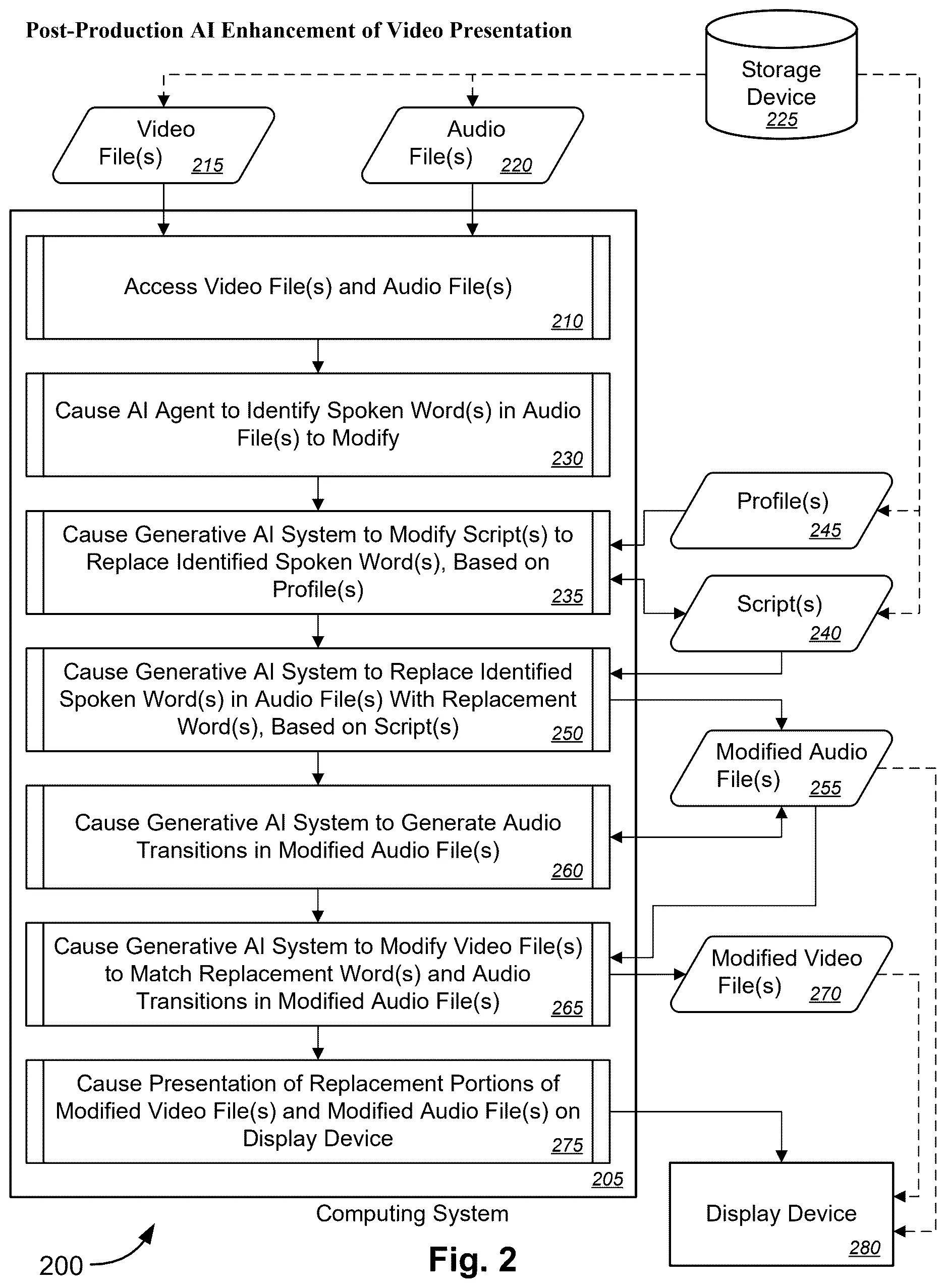
Microsoft's patent application, titled “Real-time artificial intelligence augmented video or augmented reality live presentation technology”, describes a live pipeline that flags spoken phrases, replaces, deletes or rewrites them within a few seconds of capture, and re-renders the speaker's mouth and facial motion so the revised line looks original. Filed in April 2025 and published in October 2026, it is still a patent application rather than a product — which makes it more useful read as a case file on latency, provenance and verification duty than as a roadmap announcement.
What the patent actually proposes
The claim is a conditional editing loop, not a beautification filter. The system continuously listens to the incoming live audio stream; an AI agent identifies the words or phrases that need adjustment according to configured parameters; generative AI then performs the replacement, deletion or rewrite; and the same pipeline modifies facial motion, lip shape and mouth trajectory inside the affected video frames so the finished feed appears unchanged. Transitions before and after each edited segment are smoothed to make the change hard to notice.
- Detection layer: streaming speech recognition plus parameter-driven phrase selection, deciding which utterance counts as a target.
- Language layer: substitution, deletion or rewriting of the flagged content, with automatic retrieval from web search proposed in some configurations to find a more accurate or context-appropriate phrasing on the fly.
- Visual layer: regeneration of lip shape, mouth movement trajectory and surrounding facial motion to match the new audio.
- Continuity layer: blending across cut points so audio and video do not visibly break.
- Evidence layer: retention of the untouched audio and video as a “baseline record of truth”, plus digital identifiers in some variants to preserve traces of the edit.
Microsoft's own framing is “near-real-time”: only a few seconds separate capture from the modified output. The document covers both post-production and live use, and it lists the same core value proposition throughout — a cleaner feed with far less manual editing work.
Is near-real-time rewriting already an engineering fact?
Yes for the visual half, still open for the language half. The hardest-sounding piece in the filing — re-drawing a mouth in a moving video fast enough for a live show — is what open-source models already do. MuseTalk, released in 2024 by Tencent Music Entertainment's Lyra Lab, performs single-step latent-space inpainting on a 256×256 face region instead of multi-step diffusion, and its project documentation reports inference at 30 fps or better on a single NVIDIA Tesla V100 (see the MuseTalk repository). Once a face can be re-animated at video rate on one datacenter GPU, a few-second pipeline delay for audio substitution plus re-rendering becomes a systems problem rather than a research problem.
The language half is where latency and error rates remain unresolved. Deciding which words to change means transcription under accents and room noise, a semantic judgement about whether the change is cosmetic or propositional, then re-voicing with matching prosody. The comparison below maps each stage of the patent onto shipping technology and the constraint that dominates it.
| Pipeline stage | What the patent describes | Closest shipping analogue | Dominant constraint today |
|---|---|---|---|
| Phrase detection | AI agent recognises words or phrases needing adjustment | Live captioning and streaming moderation classifiers | False positives on accented or noisy speech |
| Speech substitution | Replace, delete or rewrite the flagged content | Filler-word removal in podcast and meeting tools | Prosody and voice-identity continuity |
| Mouth and face re-render | Modify facial motion, lip shape, mouth trajectory | Real-time lip-sync models at 30 fps+ on one V100 | Temporal consistency under fast head motion |
| Continuity smoothing | Blend audio and video around each edit point | Frame interpolation and video inpainting | Detectable discontinuity at cut boundaries |
| Truth anchoring | Keep untouched media as a baseline record of truth | Signed provenance manifests such as Content Credentials | Trust anchor survives re-encoding and re-upload |
| Live retrieval | Web search auto-generates replacement wording | Retrieval-augmented assistants | Unverified text injected without review |
Case file one: the January 2024 call that cost $25 million
The capability curve stops being theoretical when you look at what attackers already achieved with far weaker tooling. According to a World Economic Forum account published in February 2025, a finance employee at engineering firm Arup's Hong Kong office joined a video call with participants who appeared to include the company's UK-based chief finance officer and colleagues. The employee was asked to move funds and to keep the matter quiet; the transfers ended as 15 separate payments to five Hong Kong bank accounts, totalling roughly US$25 million. Arup's chief information officer, Rob Greig, later discussed the lessons the firm drew from the incident.
The technical point matters more than the headline number: the perpetrators did not need a patent-grade rewrite engine. They needed face and lip animation good enough to survive a lossy conference call, plus low enough latency to hold a conversation. That is the same visual layer the patent describes, deployed adversarially.
Scale the fraud context and the risk stops looking niche. The FBI's Internet Crime Complaint Center reported more than US$16 billion in losses for 2024, a 33% year-on-year jump (see the FBI press release of April 2025), and Nacha, drawing on the same IC3 data, found almost US$8.5 billion of business email compromise losses reported across 2022 to 2024. Video-call impersonation sits inside that BEC family.
Reusable lessons for platform and security teams:
- Verification has to be out of band. A callback to a known number defeats synthetic video; a challenge inside the same call does not.
- The social wrapper did the work. Secrecy instructions and authority framing outperformed graphical fidelity — a control that ignores human factors will keep losing.
- Latency is a defence budget. Every second a pipeline buys for re-rendering is also a second removed from a real-time consistency check.
- Treat presence of a face on screen as weak evidence, not identity evidence, in any payment or authorisation workflow.
Case file two: the “baseline record of truth” already exists — and it is thinner than it sounds
The patent's mitigation clause is unsurprising, because the industry has been building the same idea under another name. Provenance metadata for digital media is standardised by the Coalition for Content Provenance and Authenticity, whose open specification lets publishers record origin and edit history — see c2pa.org. Microsoft itself already ships the pattern: content credentials documentation on the Microsoft Learn platform describes how generated images from Azure OpenAI carry provenance metadata, so the technical primitive behind a “baseline record of truth” is in production inside Microsoft's own stack.
Three limits apply, and they are worth flagging as analysis rather than as anything the filing states. First, signed manifests survive only as long as the container does: a re-encode, a screen recording or a re-upload strips them. Second, archiving unmodified audio and video at seconds-level granularity turns every broadcast into an evidentiary data set, with retention, access-control and jurisdiction costs that a patent figure never shows. Third, keeping a hidden original while presenting an edited feed places the verifier and the editor in the same organisation — the exact conflict that independent attestation and machine-readable edit manifests are meant to break. The same agentic pattern is already moving into products elsewhere: AI coworkers that keep running inside enterprise workspaces show how little separation today exists between an agent that edits content and an agent that decides what content is true.
Case file three: the rulebook reached the problem before the patent did
If the rewriting pipeline is ever commercialised, disclosure is not a design preference — in parts of the market it is already statutory. Article 50 of the EU AI Act, whose transparency obligations apply from 2 August 2026, requires users to be informed when they are interacting with an AI system and requires deployers to label artificially generated or manipulated audio-visual “deepfake” content (see the Article 50 text and commentary). The European Commission's Code of Practice on Transparency of AI-generated Content was being assembled during 2026 to operationalise those duties.
That timeline matters for interpretation: the obligations took effect two months before the application was published in October 2026. In practice, a feature that silently rewrites a broadcast and re-animates the speaker's face would be an in-scope system needing both a viewer-facing notice and a machine-readable label, not a convenience filter.
Which scenarios hold up and which do not
The filing lists real-time translation as a central use case, alongside automatic cleanup of “um” and “uh” fillers, correction of slips of the tongue, pronunciation mistakes and imprecise wording, audience-level filtering of profanity, sensitive terms, offensive expressions and some regional dialect words, and use in lectures, awards ceremonies, sports broadcasts, cooking programmes and live television generally. Split by value against irreversibility of the content claim, the set fractures cleanly.
| Scenario | Engineering value | Authenticity exposure | Working verdict |
|---|---|---|---|
| Live translation with matched lip movement | High: removes subtitle and dubbing friction for global keynotes | Medium: terminology errors change meaning at speed | Deployable with verbatim archive and on-screen disclosure |
| Filler-word and slip cleanup in recorded lectures or cooking shows | High: cuts manual post-production | Low: non-propositional edits | Best near-term fit; keep untouched media |
| Sports commentary and live entertainment | Moderate: fewer retakes, tighter pacing | High: factual claims land in the same stream as opinions | Limited to cosmetic edits under an audited rule set |
| Political statements, corporate disclosures, news | Low relative to cost | Severe: alters the record itself | Not defensible without independent, real-time attestation |
| Audience-specific word filtering | High for commercial packaging | Structural: produces divergent versions of one shared event | Highest trust risk of the group |
| Web-search auto-replacement during a live feed | Novel | High: retrieval errors injected unreviewed | Should stay behind a human confirmation step |
The trust argument is the least obvious one in the table. Filtering wording by audience preference creates different transcripts of the same broadcast for different viewer groups; authenticity then becomes a question about which population saw which version, not merely whether the file is signed.
Five readings this filing does not support
- “This is a Microsoft product.” It is a patent application. Nothing indicates a shipped feature or a committed roadmap, and most technology patents never reach a product.
- “Near-real-time means no delay.” Microsoft defines the term in the filing as a few seconds between capture and modified output — an amount that is invisible to viewers but decisive for live fact-checking workflows.
- “Only the mouth changes, so detection is easy.” The pipeline is explicitly designed to smooth around edited segments and to adjust broader facial motion, so single-frame artefact checks are the wrong test.
- “Storing the original solves authenticity.” Storage preserves evidence but not public trust; distribution of the edited version still needs labels and independent verification.
- “Translation dubbing is harmless.” Translation is still rewriting, and under EU transparency duties from 2 August 2026 the output would need disclosure regardless of intent.
Action recommendations for engineering and content-operations teams
- Log the untouched feed first. Any live AI editing pilot should begin dual-track recording of the original stream as its baseline record of truth, before a rewrite path exists at all.
- Write the edit manifest. Store segment offsets, the source rule, the substituted wording and the model version alongside every automated change, and bind it with provenance metadata.
- Set a latency contract in two numbers. Capture-to-output delay and viewer-perceived delay are different budgets; publish both, and cap the second at a few seconds only for cosmetic rules.
- Whitelist edit classes, not models. Permit filler removal and pronunciation repair; block edits that alter named entities, figures, commitments or negations unless a human confirms inside the window.
- Instrument detection as a red team task. Run consistency checks on cut boundaries and lip-sync drift, and treat conference-call impersonation drills as a standing control.
- Keep regulated speech out of scope. Earnings calls, political addresses and news reporting should remain outside any live rewrite path until attestation is independent of the editor.
- Prepare the disclosure sentence now. A short viewer-facing notice plus a machine-readable label is cheaper than retrofitting compliance after a public incident.
FAQ: what technical readers keep asking
Has Microsoft built a system that changes what people say on live TV?
No. The public document is a patent application filed in April 2025 and published in October 2026. It describes possible configurations, and a filing of this kind does not imply a product, a beta or a commitment to ship.
How much delay does the approach add?
The filing characterises processing as near-real-time, meaning a few seconds from capture to modified output. That is short enough for broadcast tolerance and long enough for a live verification step — which is why the delay should be treated as a design surface, not an inconvenience.
Could an edited broadcast be proved edited?
Only if the operator preserves the untouched audio and video and exposes an auditable edit record. Digital identifiers and signed manifests help, but they are stripped by re-encoding, so out-of-band verification and platform-side attestation remain the strongest checks.
Does the risk only exist for malicious actors?
No. The same visual layer that cleans “um” and “uh” from a cooking programme also supports audience-specific wording changes. Commercial filtering is where authenticity risk becomes structural, because different audiences receive different versions of one event.
Where does the governance debate inside Microsoft stand?
Questions about AI authority and limits are being argued at the company's top level, not only in patent language; our column's take on Microsoft AI CEO Mustafa Suleyman's digital-species warning covers that side of the record.
Reference sources
- Patent coverage: Futurism, reporting the application exposed by patent-monitoring platform Patentlyze — https://futurism.com/artificial-intelligence/microsoft-patents-ai-words-in-peoples-mouths
- Real-time lip-sync engineering: Tencent Music Entertainment Lyra Lab, MuseTalk project repository — https://github.com/TMElyralab/MuseTalk
- Case record: World Economic Forum, lessons from the US$25 million deepfake video call at Arup — https://www.weforum.org/stories/emerging-technologies/deepfake-ai-cybercrime-arup
- Loss data: FBI Internet Crime Complaint Center annual press release — https://www.fbi.gov/news/press-releases/fbi-releases-annual-internet-crime-report
- Regulation: EU AI Act Article 50 transparency obligations — https://artificialintelligenceact.eu/article/50/
- Implementation guidance: European Commission Code of Practice on Transparency of AI-generated Content — https://digital-strategy.ec.europa.eu/en/policies/code-practice-ai-generated-content
- Provenance standard: Coalition for Content Provenance and Authenticity — https://c2pa.org
Why this case file is worth keeping open
Treated as a case study rather than a headline, the filing has a clean sequence of findings: the visual layer is already commodity, the language layer is not, the evidence layer is standardised but fragile, and the compliance layer is already law in one major market. The transferable lesson for anyone building with real-time generative pipelines is that capability arrives in stages while verification duty arrives all at once — and the teams that log an untouched feed on day one are the ones that can defend every later automation decision.