
APACTechDigit AIFrontierTech Case Review: OpenAutark Tests the Limits of Local Multi-Agent Automation
OpenAutark is a local, open-source, multi-agent desktop platform created by 14-year-old developer Stanislaus Hees from Salzburg, Austria, and his team at Teydra Lab. It runs agents on the user's own computer, moves between Anthropic, OpenAI and local open models, and exposes workflows through an Apache 2.0 licence, aiming to reduce cloud API lock-in.
The case is not a funding announcement or a leaderboard test. It is a small engineering signal: the German root Autark means self-sufficient, and the project frames its purpose as an "open, self-sufficient and highly resilient" foundation for agents that must keep working when cloud dependencies break. Public coverage of the project was reported on 8 November 2026 by a NetEase technology article.

What triggered the build?
Commercial multi-agent offerings such as Perplexity Teammates have made agent collaboration an accessible product category. Hees's origin story sits on the other side of that trend: while using Claude Code and OpenAI Codex, he repeatedly encountered single-platform capability limits and friction across ecosystems. Rather than accept one AI vendor's boundaries, he built a desktop layer where agents can mix Anthropic, OpenAI and local open-source models. The target was not merely a better prompt window; it was a local execution substrate for Teydra's broader Proactive Agent Workforce idea.
How does it try to reduce vendor lock-in?
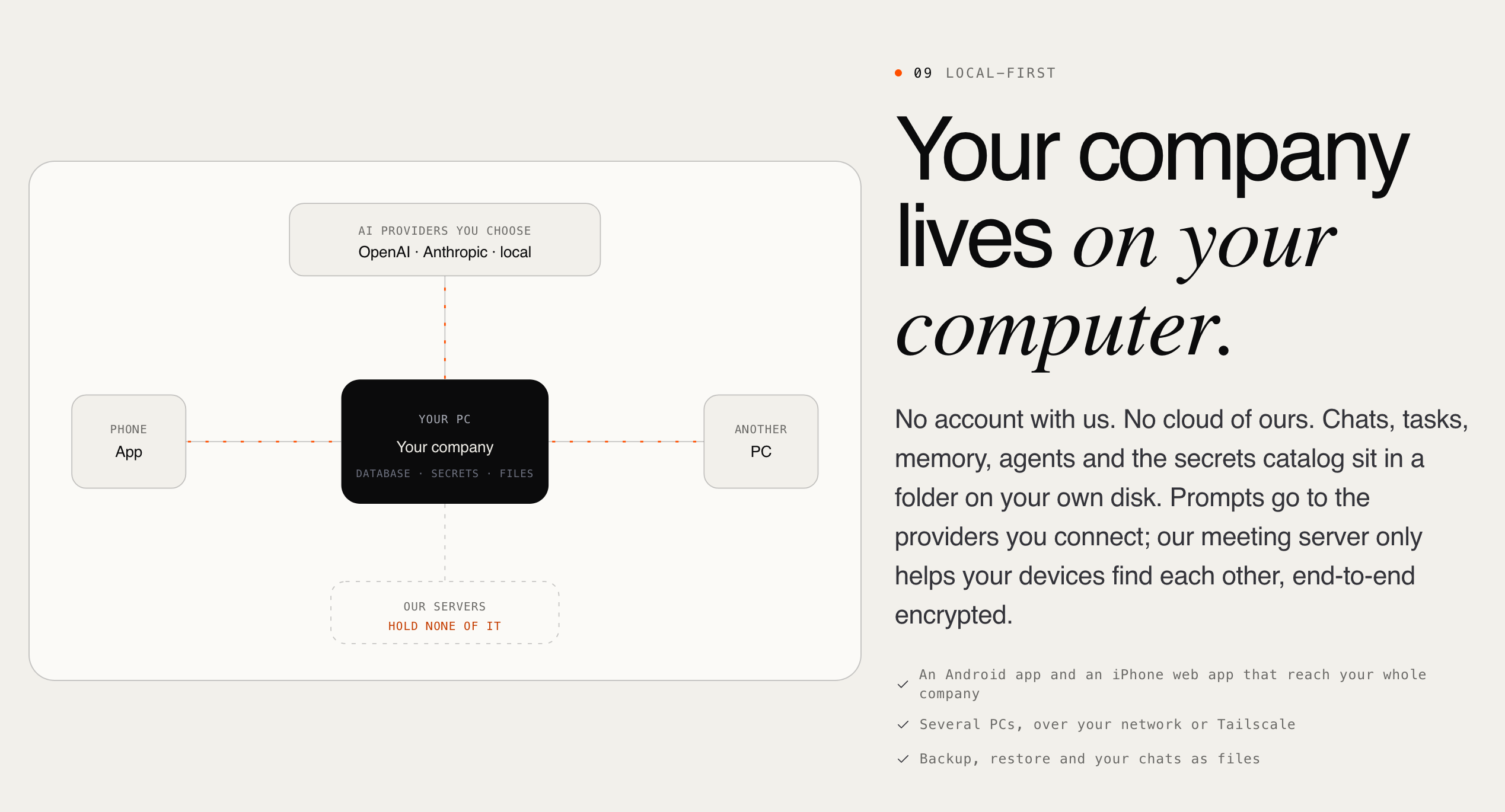
OpenAutark separates the model layer from the execution layer. A Manager Agent divides work, child agents keep their own role, memory and task list, and handoff is possible between agents. The model router can call Anthropic, OpenAI or local open models through runtimes such as llama.cpp, Ollama and vLLM. For high-frequency, repetitive automation, local quantized weights can absorb routine tokens, while paid cloud frontier models are reserved for harder subtasks. The public description of this architecture says long-term total cost of ownership can improve by several times to dozens of times when such workload splitting is stable. That claim should be read as an engineering hypothesis, not a measured APACTechDigit benchmark.
What did the self-built agent case show?
The most concrete case in the public record is Hees using the tool to build the tool. His agent team helped develop the software and even identified previously missed media news contact requests before routing them for human review. The result is small but instructive: the value did not come from generating a long answer; it came from background monitoring, dependency analysis, tool calls and a confirmation handoff. The lesson for teams is to start with low-risk inbox or status scanning, not autonomous code merges.
Why does local autonomy matter under EU rules?
As EU regulation tightens, moving trade secrets, internal communication or core code into public cloud APIs can create compliance friction. OpenAutark's pitch is that autarky can be implemented at software engineering level: an organisation can run a full multi-agent chain on local servers or a trusted private cloud, so sensitive data remains inside the corporate network during the task lifecycle. The argument rests on digital sovereignty. The EU's GDPR baseline, described in EUR-Lex Regulation 2016/679, has applied since 25 May 2018, which makes data-minimisation, access-control and audit expectations difficult to treat as late-stage cleanup. For finance, public sector, healthcare and proprietary research, that is the main reason a local agent runtime may be more attractive than a pure browser agent. It also echoes why enterprise disclosures now treat agent unpredictability as a business risk.
Where does it fit in agent product design?
The project is tied to Teydra and Teydra-Extensions, which provide standardized sandbox and call interfaces for external APIs, filesystems, databases and Proactive Agent desktop automation. Most AI products still operate as a passive chat box around a user asks - model generates loop. OpenAutark's stated ambition is to move into a proactive autonomous workflow: agents monitor events, analyse task dependencies, invoke tools and ask for confirmation at key checkpoints. The distinction matters because a chat interface fails when work is continuous, cross-system and partially observable. It also aligns with Teydra's Proactive Workforce concept, which treats agents as digital labour that acts between human prompts rather than only after them.
What engineering lesson does the architecture offer?
Open-source agent demos often depend on fragile cloud assumptions: a changed API endpoint, a rate limit or a disconnected laptop can stop the workflow. The case argues for a modular, lightweight and self-sufficient stack with transparent decision paths, audit trails and takeover mechanisms. This is the anti-fragility (Anti-fragile) claim: the system should degrade into local execution or human-controlled fallback instead of failing completely. Without that discipline, open AI toolchains remain a geek toy; with it, they can approach production-grade infrastructure. The project leans on an anti-fragile operating premise rather than a guarantee.
Cloud API vs local stack: what should readers compare?
| Decision dimension | Cloud-first agent stack | OpenAutark-style local stack | When local wins |
|---|---|---|---|
| Data path | Sensitive context is sent to vendor APIs | Agents compute on the user's computer; cloud services only connect devices | Restricted code, health data or procurement files |
| Model dependency | Often one frontier provider | Anthropic, OpenAI and local open models via llama.cpp, Ollama, vLLM | Need fallback, offline operation or private inference |
| Control plane | Provider policy can change rate limits | Teydra-Extensions provide sandboxed tool interfaces | Need audit trail and takeover |
| Capacity | Scales by account quota | Early-stage; agent concurrency is limited by RAM | Single-user desktop or small team before heavy parallelism |
What are the real limits?
The project is still early. The public feature list states that the client is free, based on the Apache 2.0 licence, and available for Windows, macOS, Linux and Android. Source code is hosted on GitHub. But the same description warns that the number of agents running at the same time is constrained by device memory, RAM. That turns a policy debate into a hardware question: a laptop with modest RAM may be fine for one review bot and one email watcher, but not for parallel multi-step engineering jobs.
One licensing detail also matters: Apache License 2.0 includes an explicit patent grant from contributors, according to the official Apache License text. That may reduce redistribution uncertainty for modified agent code, but it does not replace model-provider terms, data-processing review or security testing.
What mistakes should technical readers avoid?
- Confusing "local" with "safe". Device encryption, backups, extension permissions and audit logs still need policy.
- Overestimating RAM. Concurrency is not unlimited; early agent frameworks can hit memory ceilings quickly.
- Letting a model edit production code before a review gate exists. Human-in-loop should be a technical control, not marketing language.
- Assuming cost savings are automatic. Several times to dozens of times in total cost of ownership only appears when local inference quality is adequate and workflows repeat often enough.
- Treating the project as a finished enterprise platform. It is closer to an early architectural prototype than a completed vendor system.
FAQ: what decision-ready answers can be given?
Is OpenAutark a direct replacement for a commercial Teammates product?
No. It is an open-source desktop alternative oriented to local execution, model portability and workflow control, not a managed enterprise service.
Can it work without internet?
The architecture aims at local and private-cloud operation, so agents can continue driving business logic on an offline or restricted network when local models and tools are available.
What is the most useful first pilot?
A narrow inbox or ticket review task with human confirmation. That mirrors the self-development case and avoids giving autonomous code execution too early.
Is Apache 2.0 enough for internal deployment?
Licence terms are a starting point. The patent grant in Apache License 2.0 is useful, but compliance still requires provider contracts, data mapping and security review.
What should APACTechDigit readers do next?
For engineers, the reusable pattern is not "run every agent locally" but "make local execution a first-class fallback". A sensible evaluation starts by mapping data sensitivity, RAM capacity, repeated task volume and acceptable model quality. Then route simple monitoring jobs to local open models, keep sensitive actions behind confirmation steps, and reserve external frontier APIs for tasks where their latency and reasoning gains are measurable. For product owners, OpenAutark is best treated as an architectural test: can the workflow survive the loss of a single vendor, and can the audit trail answer a compliance reviewer's questions? If the answer is yes, the project moves from geek toy toward production-grade infrastructure; if not, it remains an interesting prototype.
Reference sources
- APACTechDigit AIFrontierTech report on Perplexity Teammates: https://apactechdigit.com/aifrontiertech/perplexity-teammates-enterprise-ai-agent-launch
- NetEase report on Stanislaus Hees and OpenAutark, 8 November 2026: https://m.163.com/news/article/LB6JS9660511BLFD.html
- EUR-Lex, Regulation (EU) 2016/679, applicable from 25 May 2018: https://eur-lex.europa.eu/eli/reg/2016/679/oj/eng
- Apache Software Foundation, Apache License, Version 2.0: https://www.apache.org/licenses/LICENSE-2.0
APACTechDigit AIFrontierTech view: OpenAutark's value is not the age of its creator or the novelty of "local AI". The practical signal is that agent design is moving from a single provider's chat loop into a distributed control problem: model routing, memory limits, extension sandboxes, audit trails and human takeover. Those are the parts that decide whether an agent stack stays a personal automation experiment or becomes usable infrastructure.