
APACTechBriefing Case Review: Inside Qwen4-Max's 58% Cost-per-Task Drop — An APAC Buyer's Playbook
Alibaba's Qwen4-Max cuts the average cost of a long, tool-heavy task by 58% versus Qwen3.8-Max — the clearest enterprise case for upgrading yet. For APAC technology leaders weighing AI adoption across multiple markets, that efficiency gain matters as much as raw capability: it turns previously uneconomic agent workflows into repeatable, budgetable operations. This brief reviews what changed, how the result was measured, and which lessons travel across the region.
What actually changed in the Qwen4-Max upgrade?
It is an efficiency story, not a parameter-count story. Alibaba built Qwen4-Max on a new Mixture-of-Experts (MoE) architecture anchored by Qwen Sparse Attention (QSA). Of its 2.4T total parameters, just 71B are activated per token — 25% fewer than the previous generation — and the model carries native vision understanding plus a one-million-token context window.
For APAC teams running localization workloads and multi-country rollout, that combination matters: long, mixed-language documents stay in a single pass instead of being chunked across calls, which is where latency and cost usually creep in.
How was the 58% cost-per-task drop measured?
The headline result comes from a controlled like-for-like test, which makes it reusable as an upgrade benchmark. In the Terminal-Bench 4.0 professional coding evaluation at the same Xhigh thinking tier, Qwen4-Max cut average tokens per attempt from 289K (Qwen3.8-Max) to 151K — close to 50% lower — while the score climbed from 38.9 points to 48.5 points, nearly 25% higher. With cache-hit pricing also falling, measured average Cost per Task was 58% below Qwen3.8-Max; Alibaba's wider launch framing put average single-task spend down 60% against the prior generation. Alibaba Cloud's enterprise channel labels this task-cost benchmark the Work360 evaluation.
| Metric (Terminal-Bench 4.0, Xhigh) | Qwen3.8-Max | Qwen4-Max | Change |
|---|---|---|---|
| Avg. tokens per attempt | 289K | 151K | ~50% lower |
| Evaluation score | 38.9 points | 48.5 points | ~25% higher |
| Cost per Task | baseline | lower | 58% lower |
Terminal-Bench 4.0 is an open-source benchmark of 66 professional computer-work tasks spanning software, machine learning, science, operations, security, hardware and media, per the benchmark's methodology page — breadth that makes the result more decision-useful than a single coding score.
Do the benchmarks hold up outside Alibaba's own tests?
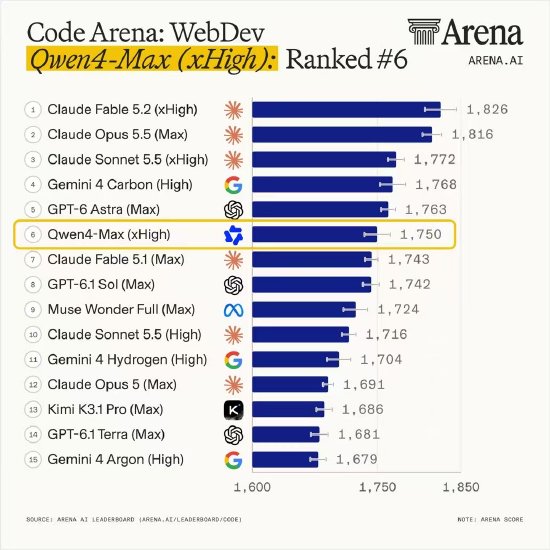
Third-party results are strong but not uniform — a nuance APAC buyers should price in. In the global front-end coding blind test CodeArena, Qwen4 ranked sixth, and across Agents' Last Exam (ALE) and Vals Index it sits in the leading tier. One independent comparison put Qwen4-Max at 63.20% versus 59.05% for Qwen3.8-Max on Vals Index.
VentureBeat nonetheless framed the release as an 'uneven challenge to frontier rivals' and noted that, unlike many earlier Qwen releases, Qwen4-Max is not an open-weights model. Alibaba has said smaller sizes in the Qwen4 family will be open-sourced in due course — a distinction that changes the deployment math for teams assuming self-hosting.
What is the commercial price for APAC buyers?
Cache-hit pricing is the lever that makes the cost-per-task drop real. Qwen4-Max is live on the Qwen AI Platform with API access, with cache-hit pricing as low as 0.5 yuan per million Tokens. Trade reporting also cites a published list price of $1.50 per million input tokens and $4.50 per million output tokens.
Access is not limited to the API: users can reach the model through Alibaba Token Plan and inside Qwen Office, Qoder and Qwen App. Buyers benchmarking against other frontier launches can compare with our brief on Gemini 4 Carbon's general availability pricing, while the broader tilt toward Chinese models is tracked in what APAC buyers should decide as open-model spend shifts to China.
Which compliance and rollout risks should teams flag?
Efficiency gains are real, but cross-border data compliance remains the gating item for multi-country rollout. APAC has no single rulebook: IAPP has documented new AI-governance and data-protection measures in China alongside simplified compliance for small-scale data handlers, while other markets set their own localization requirements. Because Qwen4-Max is delivered via API rather than open weights, prompt and output data flows need review under each market's residency rules.
This is our analysis, not a vendor claim: confirm data-flow, retention and jurisdiction terms directly with the provider before production deployment.
Action checklist for APAC evaluators
- Re-run a Terminal-Bench 4.0-style task set on your own workloads to confirm the 289K to 151K token reduction holds for your prompts.
- Measure Cost per Task with cache hits enabled, using 0.5 yuan per million Tokens as the floor.
- Check whether open-weight smaller Qwen4 variants meet localization needs before committing to API-only Qwen4-Max.
- Map data residency market by market and verify contractual terms covering prompts, outputs and retention.
- Keep a frontier-model comparator in the pilot to test the 'uneven' benchmark picture against your own quality bar.
FAQ: Qwen4-Max for APAC buyers
What is Qwen4-Max's context length?
One million tokens, with native vision understanding.
How much cheaper is it than Qwen3.8-Max?
On Terminal-Bench 4.0 at Xhigh, average Cost per Task fell 58%; Alibaba's broader framing put single-task spend down 60%.
Can I self-host Qwen4-Max?
Not at launch — it is not an open-weights model. Smaller Qwen4 sizes are expected to be open-sourced later.
Where can I access it?
Qwen AI Platform API, Alibaba Token Plan, Qwen Office, Qoder and Qwen App.
Reference sources
- VentureBeat — Qwen4-Max task-cost and benchmark analysis
- Vals AI — Terminal-Bench 4.0 leaderboard and methodology
- DataStudios — Qwen4-Max vs Qwen3.8-Max comparison
- IAPP — Asia-Pacific AI governance and data protection
- Alibaba Cloud — Qwen4-Max for Enterprise (Work360)
Author: Nathan Hale, enterprise technology analyst at APACTechDigit.