
APACTechBriefing Q&A: U.S. Firms Paid 89% of Open-model Spend to China Models — What APAC Buyers Should Decide
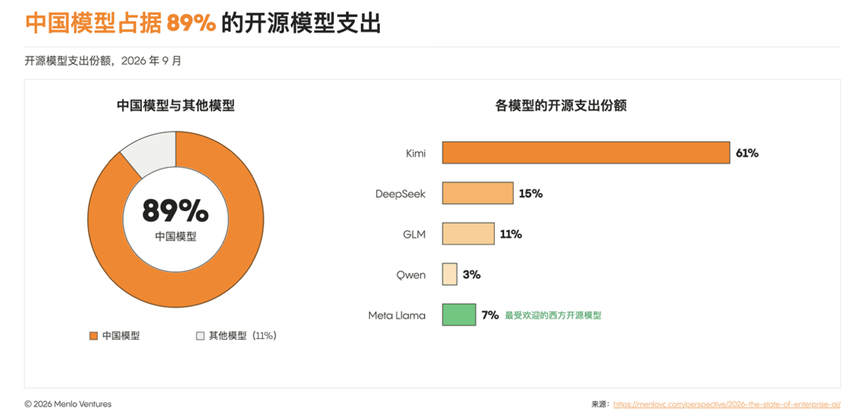
If your AI budget committee is asking why open-weight models from China are winning enterprise wallets, the answer is simpler than any technology slogan: recent procurement data shows better price performance and usable capability. A 2026 report from Silicon Valley firm Menlo Ventures estimates that 89% of U.S. enterprise open-source model spending went to Chinese models, making cost control, model selection and ownership boundaries the real decision for Asia-Pacific teams.
What did the report actually measure?
Recently, Silicon Valley venture firm Menlo Ventures published the 2026: The State of Enterprise AI report. It surveyed nearly 400 U.S. enterprise AI owners and found that 89% of spending directed to open-source large models flowed to China-based models. The respondents' combined AI budgets exceeded $4 billion. The report also puts overall enterprise AI deployment spending at about $177 billion by September 2026, up from $33 billion a year earlier.
Menlo's own framing is blunt: "As Chinese models define the open-source frontier, they account for 89% of open-source spending."
How concentrated is the model mix?
Share is not evenly spread. Moonshot AI's Kimi captured 61%, and the top three positions were all occupied by Chinese models. The open-model breakdown also lists DeepSeek at 15% and GLM at 11%, according to coverage of the Menlo report. Among Western open models, Meta Llama had the largest share at 7%.
Menlo Ventures is not a newcomer: it has invested for 50 years and backed Anthropic and Uber. That gives the estimate a practical board-level signal rather than a developer-only anecdote. For teams weighing capability claims rather than budget share, APACTechBriefing's case review of Kimi K3.1 Pro is a useful next step.
Why are enterprises choosing open models over closed APIs?
First, cost is visible. Developers can download open models and tune them to business tasks. Enterprises do not need to train from zero; they can continue research on existing weights, saving time, compute and capital. Second, the frontier has moved. When a low-cost model can do enough work, procurement stops treating open weights as an experiment and starts treating them as a default budget lever. Third, model weights being open also lets teams add task-specific training and reduces dependence on a small number of closed model vendors.
What unit economics changed in the past year?
Over the past year, the average token price of open models fell by two-thirds, from $0.45 per million tokens to $0.13. Meanwhile, usage rose 22.5 times, with monthly token volume reaching 2,900 trillion tokens, or 2.9 quadrillion. Open models accounted for 19% of total platform tokens but only 4% of enterprise model spending.
| Metric | Reported value | Decision read |
|---|---|---|
| Open-model token price | Fell from $0.45 to $0.13 per million tokens | Cheaper units change trial economics, not only budget size. |
| Monthly token volume | 22.5 times growth; 2,900 trillion tokens | Low prices are being amplified by agent-like workloads. |
| Token share vs spend share | 19% of tokens, 4% of model spending | Open models are moving volume before they move finance-line share. |
What should Asia-Pacific teams decide before copying the pattern?
For CIOs and product leads, the useful question is not "who is cheapest" but "who can be governed at this price." An open model moves cost, data paths, evaluation and support risk inside your own house. A practical route is to start with one high-friction workflow, assign one budget owner, classify data, then test whether task cost, cycle time and error rate improve enough to justify scaling.
- Name one owner for model spend, not three committees.
- Draw a data map before the first download.
- Run three task-level evaluations with real workloads.
- Define fallback terms with closed vendors.
- Track token cost, labor hours and error rate per process.
Decision Q&A: What buyers ask next
Q: Does 89% mean all enterprises switched to China models?
A: No. The estimate describes share of U.S. enterprise spending on open-source large models. Overall enterprise AI spending remains much larger and more mixed.
Q: Is low price enough to move production workloads?
A: No. Price brings a trial; workflow stability, compliance and support decide scale. The decision unit should be a process, not a model name.
Q: What is the main hidden risk for APAC teams?
A: Ownership transfer. When weights are open, the team absorbs data handling, versioning, evaluation and incident response. A budget saving can become internal labor cost if no owner is assigned.
Q: Should teams still consider Western models such as Meta Llama?
A: Yes, when ecosystem fit, regional compliance or support structure matters. The data shows Meta Llama held the largest Western open-model share at 7%, so it remains part of the menu, but not the spending winner in this measurement.
Sources
- Menlo Ventures, 2026: The State of Enterprise AI, https://menlovc.com/perspective/2026-the-state-of-enterprise-ai/
- Huanqiu Tech report coverage, https://tech.huanqiu.com/article/4Tuoa8z3Ufu
- Observer Net coverage, https://www.guancha.cn/CaiJing/2026_11_06_907362.shtml