
APACTechBriefing Case Review: DiDi's 21-Order Test Shows Why a 23.9% Commission Became a 13.22% Average
Lao Yu's 21-order experiment gives a short answer: a single order can feel punitive while the month can still look moderate. One evening rush hour order showed a 23.9% commission, leaving the driver RMB 10.5 from RMB 13.8, but after 2 days and 21 orders his calculated average was 13.22%. The case shows why ride-hailing commission debates need billing arithmetic rather than fixed ratio intuition: dynamic pricing, zero-commission orders, off-peak incentives and campaign subsidies can average out twenty-something points from one high-commission order.
What did Lao Yu's immersive driving test prove?
The test did not prove that every driver earns the same way. It proved that a small, verifiable sample can expose the difference between "this order hurt" and "my whole month looks like this." Lao Yu ran DiDi trips himself, kept the orders visible, and used his own billing record to make the argument concrete for other drivers.
- The trigger was a 23.9% commission on one low-value evening rush hour order, with the driver receiving RMB 10.5.
- After 2 days, 21 orders were pooled into a monthly-style calculation, and the average landed at 13.22%, just above 13% rather than nearly 24%.
- The spread contained high-commission orders, low-commission orders, no-commission orders and even negative-commission orders, so the average reflected a dynamic market mix.
Why did 23.9% become 13.22%?
Because the commission is a dynamic outcome shaped by time slot, supply and demand, and order type, not a fixed ratio. In evening rush hour, when traffic is congested and capacity is tight, a platform may lower the commission or add an incentive to keep drivers online. During off-peak periods or specific campaigns, mechanisms such as commission-free cards, carpooling commission waivers and new-driver protection can push some orders to zero commission or below zero.
Lao Yu's 21-order mix included a high-commission order of twenty-something points and several leveling orders that were not commission-bearing. Once all orders were pooled, the average matched the broader claim DiDi has made publicly: the average commission for 2024 all orders was 14%. The decision-relevant question is not simply "how much was taken from this fare" but "what market conditions this order is in."
What do larger samples say?
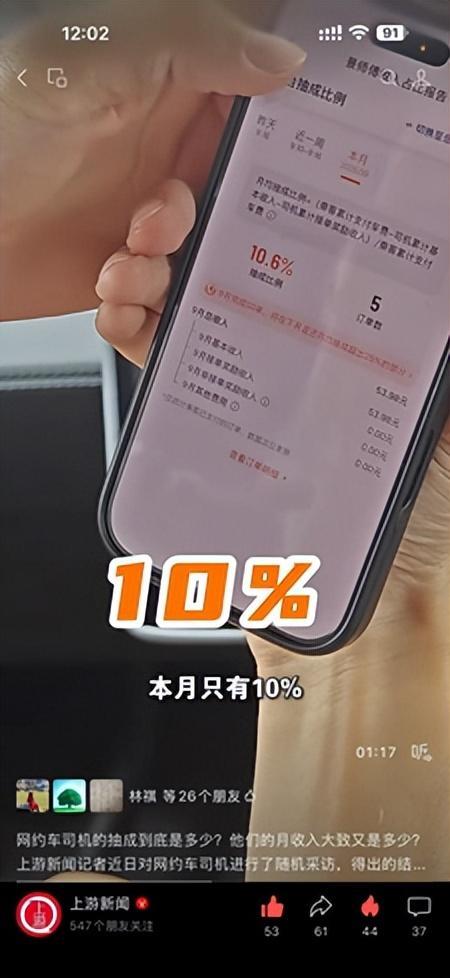
Upstream News's earlier field interviews with drivers produced a pattern: many said "the commission is high" based on feeling, yet when they opened actual records, monthly real commissions often sat in the 10-14% range rather than "20% or more." That gap is the core of the case: perception is anchored to memorable pain, while billing is distributed across a month.
The Tsinghua University team provided a larger measured sample. According to the Tsinghua report, the team surveyed 894 DiDi drivers between July to August 2025 and photographed the income report of 768 drivers. Combining what passengers paid with what drivers received, the team found a DiDi monthly average commission of 15.3%. Nine in ten drivers had monthly average commissions below 20%, and 4% of drivers had negative monthly average commissions, meaning the platform effectively returned money to them.
A Xinhua report on the same survey added a distribution view: 49.0% of surveyed drivers had monthly average commissions in the 15-20% band, and 24.6% had monthly average commissions in the 10-15% band. This does not erase the 10-14% range observed in earlier field interviews, but it shows that the center of the distribution is broader than the loudest single-order complaint.
Why did most drivers overestimate their commission?
The survey's most operationally useful finding was behavioral: 71.8% of drivers overestimated their own commission ratio. More than one-third of surveyed drivers believed their monthly average commission was above 25%, but when researchers verified the photographed records, only 1 person out of 768 people had a monthly average commission above 25%.
The mechanism is loss aversion. A driver who sees "took 23%" on one order remembers the loss for hours. A driver who sees a good order with no loss, zero commission or a subsidy often treats it as routine. Over time, the memorable outliers become a folk belief that "the platform takes too much." Lao Yu's conclusion was practical: "speak with your own real data, instead of being carried away by the emotion of one order."
How did transparency change the argument?
Since 2022, when DiDi implemented the Sunshine Action, transparent billing has moved the debate from rumor to record. Drivers can inspect each order's income and commission, and check 7-day and 30-day average commission reports. This matters for platform governance because a worker complaint is easier to resolve when the audit path is short: single order, rolling window, monthly total and cap logic should all be visible in the same product surface.
Where does the commission money go?
DiDi's public position is that commission is not the same thing as profit. The platform describes commission as a second distribution mechanism: part of the money is redirected through driver rewards, weather subsidies, off-season minimum guarantees, carpooling waivers and holiday commission-free activities. Peak hours, rain or snow, off-season and holidays are not decorative labels; they change how the commission pool is returned or redistributed.
Two cap mechanisms are especially relevant for APAC platform operators:
- DiDi lowered the single-order maximum commission from 29% to 27%.
- Through FanYongBao, drivers who complete 50 orders or more each month are protected by a monthly average commission ceiling of 25%; excess commission is automatically returned in the next month.
Driver protection has also been formalized. DiDi Driver Protection Plan 2.0 covers income protection, care benefits, rights maintenance and feedback collection. The 2026 Health Protection Plan includes public-hospital treatment subsidies and online consultations, while selected cities offer free physical exams to qualified drivers, with plans to cover more than 50,000 Express drivers nationwide this year.
A policy backdrop helps explain why these details are now visible. China's eight-department guidance published through central channels in December 2021 asked ride-hailing platforms to set reasonable commission-rate caps and strengthen transparency. In May 2026, union-guided algorithm consultation reporting highlighted DiDi's bill-transparency upgrades, including 7-day average commission views. A later central cyberspace administration governance summary also noted that DiDi extended order fee-detail lookup from 30 days to 90 days while keeping the maximum commission at 27%.
What should APAC platform and technology leaders do next?
| Reader question | Evidence from the case | Action for APAC managers |
|---|---|---|
| Is one order enough to prove a platform takes too much? | One order showed 23.9%, while 21 orders averaged 13.22%. | Require dashboards that show single order, 7-day average and 30-day average together. |
| Why do workers distrust dynamic pricing? | Loss aversion makes high-commission orders memorable; zero and negative-commission orders are forgotten. | Label the reason for each commission change: peak, off-peak, campaign, cap or rebate. |
| What is the governance risk? | Drivers often rely on feeling rather than the income report. | Make exportable receipts, caps and rebate timing auditable before disputes escalate. |
| What is the business upside? | A commission pool funds rewards, insurance, customer service, compliance, payment security and platform maintenance. | Communicate commission as a service cost and redistribution pool, not a black-box profit line. |
For APAC readers following platform trust in fast-changing digital services, this commission case also connects to broader regional governance testing, such as our APAC governance briefing on Tencent's Sogou Wenwen shutdown. The common lesson is that disclosure must be machine-readable, not merely public-facing.
FAQ: How should a platform worker check commission?
1. Should I judge the platform by the worst order?
No. The worst order can be a valid signal, but it is not the full ledger. The DiDi case shows why a 23.9% order still produced a 13.22% average across 21 orders, because the sample contained high-commission orders, low-commission orders, zero-commission orders and subsidies.
2. What should I look for in an income report?
Look for the denominator, the commission amount, the rebate rule and the window. Since the Sunshine Action, drivers can inspect 7-day and 30-day reports; after algorithm-consultation upgrades, bill transparency became a formal governance topic. The useful check is whether the report explains "how the water in the pool was distributed over a month."
3. Is FanYongBao a subsidy or a cap?
It works as a cap-plus-rebate mechanism: drivers completing 50 orders or more each month should not carry a monthly average commission above 25%. If the monthly calculation exceeds that line, the excess is returned in the next month.
Sources
- Yicai reporting on DiDi Open Day: "2024 average commission of all DiDi orders was 14%."
- Xinhua Net technology report on the Tsinghua survey: monthly average commission 15.3%, 90% below 20%, 4% negative, plus distribution bands of 49.0% and 24.6%.
- China.com.cn coverage of eight-department ride-hailing worker-rights guidance: platforms should set reasonable commission-rate caps.
- All-China Federation of Trade Unions reporting on algorithm consultation and bill transparency.