
APACTechBriefing: Tencent's Sogou Wenwen Shutdown Turns Platform Sunset into an APAC Governance Test
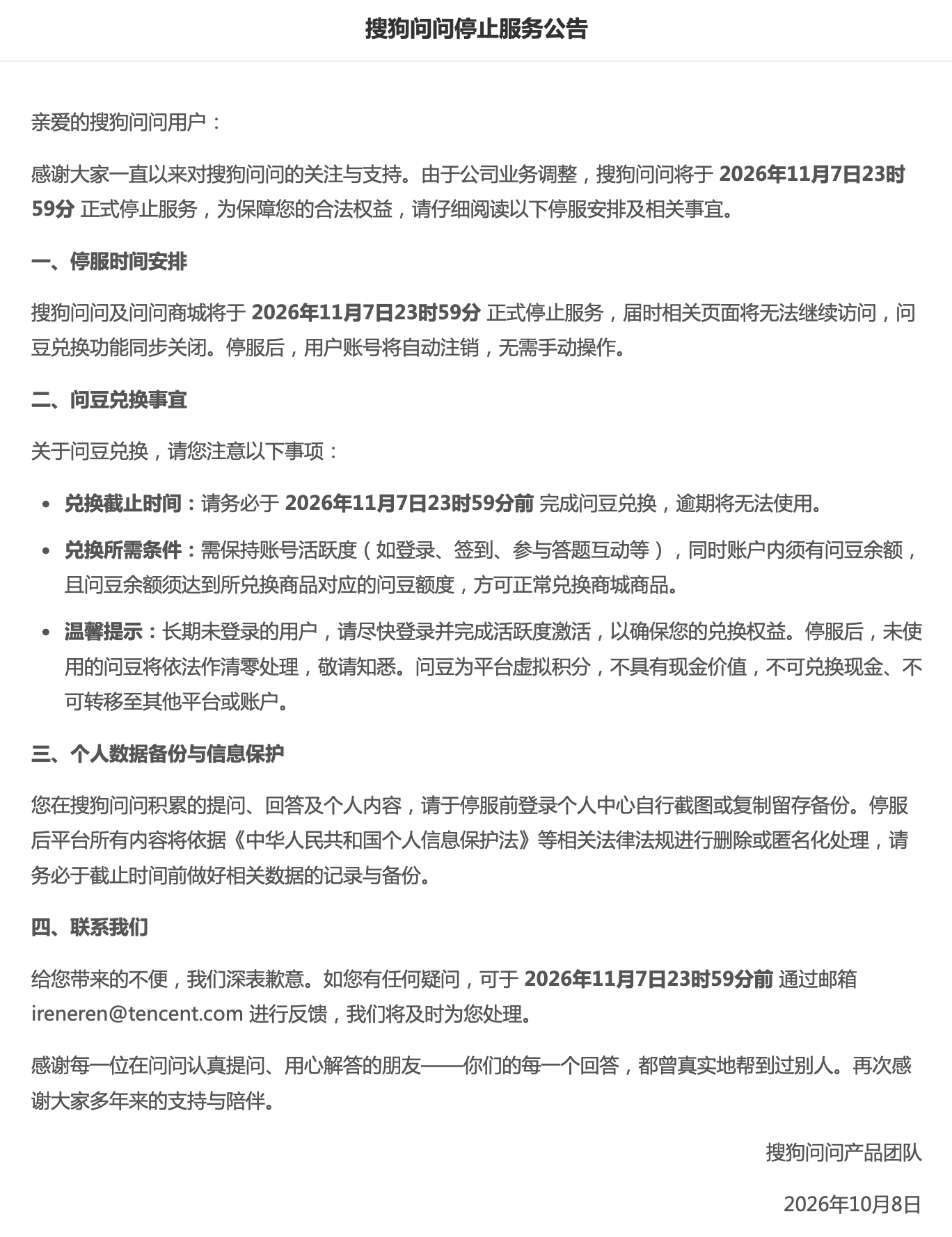
Today, Tencent's Sogou Wenwen and Wenwen Mall stop serving after the Sogou Wenwen product team announced that business adjustment will end the question-and-answer service at November 7, 2026 at 23:59. For Asia-Pacific technology teams, the lesson is less about one legacy site and more about three recurring risks: virtual-point liability, user-content ownership, and archive planning when platform lifecycles compress.
Why Tencent is closing a legacy Q&A platform
The closure is not an isolated product failure. It is the endpoint of a long integration path. Sogou Wenwen began as Tencent SOSO Wenwen in 2007, was renamed Sogou Wenwen in 2014 as Sogou reorganized its search and Q&A assets, and relied on the QQ account system to scale. By 2025, public product data had described more than 700 million users and more than 260 million resolved questions, making it one of Asia-Pacific's large legacy knowledge-sharing properties.
The company context deepened in 2021, when Sogou completed its merger with Tencent. TechInAsia reported the transaction as a US$3.5 billion going-private deal. That change placed a long-standing Q&A community inside Tencent's broader search and AI roadmap, where maintenance, monetization and data governance now compete with newer formats and model-native products.
The Sogou Wenwen product team put the immediate reason plainly: related pages will become inaccessible and Wendou redemption will close in step with the shutdown. The underlying signal for operators is sharper. When a platform says business adjustment and sets a fixed end date, the product is entering sunset management, not service recovery.
What users and teams must check before November 7 at 23:59
- Access window: Pages will be unreachable after shutdown.
- Wendou points: The redemption function closes at the same time. Users who still want to redeem must keep accounts active and retain balances before November 7 at 23:59.
- Virtual-point treatment: Unused points may be cleared by law. Official explanation: points cannot be exchanged for cash or transferred.
- Content: Users need backup via screenshot or copy. Post-shutdown, the platform can delete or anonymize content according to laws.
- Accounts: Accounts will be automatically deregistered, no manual action required.
Decision table: platform sunset versus normal outage
| Signal | What it means | APAC governance action |
|---|---|---|
| Business adjustment | Product may not return; roadmap reallocation. | Trigger archive and migration review. |
| Fixed end date | Redemption and export deadlines are hard limits. | Assign owner and pre-close balances. |
| Points cleared | Virtual liabilities are not automatically converted to cash value. | Document user consent and legal basis. |
| Content deletion or anonymization | Community memory is not preserved as public record. | Export critical content early. |
Why legacy Q&A platforms are losing relevance in Asia-Pacific
The shutdown reflects a shift from open-text communities to AI answer synthesis, short-video tutorials and private enterprise knowledge bases. This is not a guess. A CNNIC-related 2025 internet report summary showed China had 1.123 billion internet users as of June 2025, with a 79.7 percent penetration rate, while short-video services continued to consume a large share of attention. In that environment, older Q&A pages are harder to monetize and harder to keep compliant.
Platform governance is also becoming more explicit. Our earlier coverage of Apple's iOS 27.3 public-link review showed the same theme across Asia-Pacific: public content, shared files and user data are increasingly subject to automated policy checks. Teams should no longer assume that a free cloud page will remain unchanged.
Enterprise teams that still use consumer platforms as informal knowledge bases face duplicated risk. If questions are also answers, and answers are also marketing content, the loss is not just traffic. It is search visibility, customer-support continuity and compliance evidence.
APACTechBriefing action list for technology and digital teams
- Inventory any account-dependent data: support answers, creator profiles, points, coupons and legacy URLs.
- Set backup deadlines at least 72 hours before the official shutdown to avoid last-minute failure.
- Move high-value knowledge into a controlled repository with access logs, not consumer accounts alone.
- For APAC-facing products, maintain language and regional backups because compliance and indexing differ across markets.
- Review virtual-point terms before sunset; do not convert community credit into cash assumptions.
- Monitor account deletion, anonymization and content export requirements in the platform notice.
Frequently asked questions
When does Sogou Wenwen stop serving?
The service-stop time is November 7, 2026 at 23:59. The same deadline applies to Wenwen Mall and Wendou redemption.
Can users keep their Wendou points?
Only if they redeem before November 7 at 23:59 while keeping the account active and maintaining a balance. Unused points may be cleared under law and cannot be exchanged for cash or transferred.
Do users need to cancel accounts manually?
No. The Sogou Wenwen product team said accounts will be automatically deregistered after shutdown.
Why does this matter beyond one China product?
APAC technology teams often use consumer platforms as support bases, content archives or creator ecosystems. A fixed sunset date shows that availability, point balances and public content all need governance, not just uptime monitoring.
References
- Sogou Wenwen official service-stop notice: Sogou Wenwen official site
- Rednet reporting on the shutdown date and account handling: Sogou Wenwen service-stop report
- TechInAsia reporting on the 2021 Tencent-Sogou merger: Tencent-Sogou merger completion
- CNNIC-related 2025 internet-user summary: China internet users June 2025