
APACTechBriefing — Samsung vs SK hynix in the EUV Queue: What Doubled Lead Times Mean for Asia-Pacific Memory Sourcing
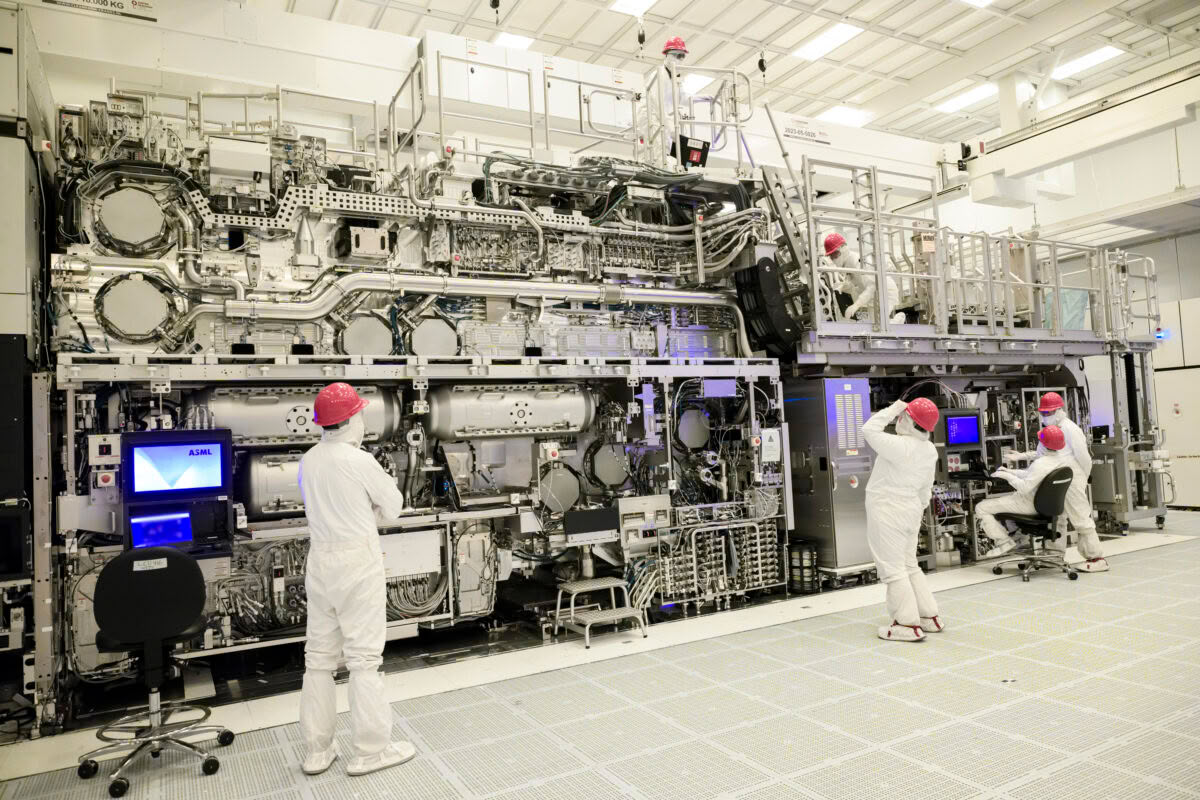
Delivery slots at ASML, not capital, have become the gating item for memory expansion. SK hynix and Samsung Electronics intend to receive EUV scanners in batches from next year, lead times on core equipment have stretched to twice the longest cycle previously seen, and the two companies are now weighing earlier ordering, with add-on purchases possible. For Asia-Pacific buyers the consequence is concrete: new DRAM capacity cannot be switched on at will, and the 2027–2028 supply curve is set by tool delivery rather than by demand signals.
Why has the bottleneck moved from money to machines?
Because each new DRAM generation consumes more lithography than ASML can add. An EUV scanner, which patterns circuits with 13.5-nanometer light, cuts the multi-patterning steps that once had to split shapes across several exposures to reach precision and yield. On the 10nm-class sixth-generation node, known as 1c, circuit spacing keeps shrinking and the layer count needing EUV keeps climbing; TrendForce says SK hynix plans to apply EUV across more than five process layers on 1c DRAM, two more layers than the previous generation.
ASML put the supply side on record in its third-quarter report this year: under current plans, 2027–2028 EUV output will not fully meet customer demand. Shipments of about 65 EUV systems this year are already up nearly 50% from 44 last year; even with capacity planned up 30% in 2027 and a further 30% under evaluation for 2028, the shortfall persists. Price increases on core products are expected to begin showing through next year and to be fully reflected in 2028, and in the third quarter of this year memory customers already accounted for 46% of ASML's system sales.
The company's own numbers sharpen the read. Its third quarter of 2026 was a record — net sales of €11.7 billion, including €8.4 billion of systems, of which €4.1 billion was EUV with one High-NA system inside, per its investor materials. Coverage by Reuters after the second-quarter call noted that expanded EUV capacity through 2027 was effectively booked. That combination explains why the queue, not the price list, now allocates capacity.
SK hynix vs Samsung Electronics: two bets on the same queue
Both are buying lithography, but they optimize different variables. SK hynix is buying schedule certainty for 1c and HBM-related output; Samsung Electronics is buying site capacity for a multi-year build-out at the Pyeongtaek campus.
| Decision dimension | SK hynix | Samsung Electronics |
|---|---|---|
| Disclosed order | About 11.95 trillion won of EUV equipment announced in March, with a delivery deadline of December 31, 2027 | Orders expanded in step with Pyeongtaek; lithography for the P5 line already placed |
| Capacity vehicle | Mass production of next-generation products, covering advanced DRAM and HBM-related capacity | Five-year 450 trillion won domestic investment plan announced last November, P5 included, targeting production in 2028 |
| Site and cost | M16 fab in Icheon, where the first EUV tool was installed in February 2021 | A single P5 fab exceeds 60 trillion won; phase one cleanroom work is expected to finish in the first half of next year, after which tools move in |
| EUV depth | More than five EUV layers on 1c DRAM, two more than before (TrendForce) | Shipped the industry's first EUV-based DRAM module in March 2020 and today holds the most EUV tools in memory |
| High-NA position | Brought in the industry's first High-NA EUV production tool last September | Announced on September 8 an expanded partnership with ASML, aiming to bring High-NA EUV into DRAM mass production in 2028 |
| What can still go wrong | Slot risk: whether the delivery calendar holds as volumes build | Sequencing risk: cleanroom, tool move-in and qualification must line up; per-wafer litho intensity keeps rising |
The trade-off changes contract conversations. A buyer that needs bits inside the next four to six quarters should read SK hynix's pre-committed delivery deadline as the nearer-term anchor; a buyer planning platform roadmaps through 2029 should treat the P5 timeline as the swing factor, because those bits arrive only after construction, installation and qualification. Korean business media covering the race put each company's EUV outlay in the 10 trillion to 20 trillion won range — evidence that cash is not the constraint and that the delivery calendar is.
Front-end litho or back-end bonding: which queue is tighter?
Short answer: both, for different reasons, and the back end is now the one most APAC system makers underestimate.
- Front end: EUV and other core tool lead times have run out to twice the longest period previously seen, which pushes first output from new lines to the 2027–2028 window.
- Back end: order books at equipment suppliers are already filled for two to three years. HANMI Semiconductor and Amkor are reported to have their order reserves essentially in place, and both are expanding production of key process tools needed for AI data-center chips, including thermal-compression bonders (TC bonders).
- Back-end evidence added this year: TrendForce's news desk, citing ET News, reported a 44.2 billion won TC bonder order from SK hynix to HANMI Semiconductor tied to the HBM4 ramp. DIGITIMES reported that HANMI showed the TC Bonder 4 at SEDEX 2026 and is targeting a wide TC bonder launch in 2027 while broadening its 2.5D AI-chip packaging line-up.
- Financing pattern: equipment and packaging houses are taking money from customers ahead of delivery. Amkor's third-quarter 2026 call summary described narrowing 2026 capital spending to about US$2.5 billion and pointed to advance-payment arrangements with roughly a dozen customers since 2025 supporting capacity in Korea and Arizona.
- Cost reality: High-NA EUV scanners are priced at roughly US$400 million per tool, about double a conventional EUV system according to CNBC, which makes a High-NA decision a capital-allocation question as much as a technology one.
A semiconductor industry insider framed the shift: "For AI data-center chips, it is not only the advanced front-end process that matters; to reach large capacity and high performance, the back-end steps that build multi-dimensional package interconnects on a single chip keep rising in value. As the ecosystem takes shape, HANMI Semiconductor and Amkor are now tied closely to the same upcycle as the big front-end makers."
What the equipment queue does to Asia-Pacific prices
The near-term data supports the tighter-supply reading. TrendForce projected server DRAM contract prices up 13–18% quarter on quarter in the third quarter of 2026, and in late September raised conventional DRAM contract prices to a 10–15% quarter-on-quarter increase for the fourth quarter of 2026, with NAND flash up 15–20%.
Our analysis, consistent with the facts above: because 2027–2028 bit growth is gated by tool delivery rather than by willingness to spend, the cycle has a longer floor than usual, and the relief that a capacity announcement would normally bring is deferred. That asymmetry shows up in regional trade data too — we tracked the macro side in our briefing on Korea's road to a US$1 trillion export year — and in vendor revenue share, broken out in our buyer's scorecard of the Q3 DRAM reshuffle.
Decision checklist: five moves for buyers, IT leads and strategy teams
- Move allocation decisions 12–18 months earlier. In this cycle the negotiation variable is the delivery slot, not the unit price.
- Write slot language into contracts: milestone dates, rescheduling terms and prepayment exposure, mirroring the long-agreement discipline the memory makers themselves are adopting.
- Qualify dual sources on prior-generation nodes where specifications allow, and plan 1c-dependent designs with a named second source before tape-out.
- Track back-end capacity as a leading indicator — bonder orders and packaging expansions signal which customers are being served first, and HBM4-related tooling shows where the queue is longest.
- For investors and strategy teams, separate capex headlines from effective supply: a fab announced is not a fab shipping, and the pass-through of equipment price increases from next year is the margin variable to model.
FAQ: what Asia-Pacific readers are asking
Is this a shortage of EUV tools or of everything?
Both, but the sequencing differs. ASML has said current plans will not fully cover 2027–2028 EUV demand, while back-end suppliers already report order books filled for two to three years, so the front-end calendar and the packaging calendar bind at different points in the production flow.
Why not simply order more scanners?
Output is the limit. ASML is lifting EUV capacity about 30% in 2027 and is evaluating another 30% for 2028, from about 65 systems this year against 44 last year — so extra orders mostly change queue position, not total availability.
Does High-NA EUV change the economics?
It raises the stakes. At roughly US$400 million per system, High-NA is a multi-year commitment; SK hynix took the industry's first High-NA production tool last September, while Samsung has scheduled High-NA for DRAM mass production in 2028.
Should APAC system makers expect relief in 2027?
Not automatically. Tools delivered in 2027 must still be installed, qualified and ramped; combining the equipment calendar with TrendForce's price outlook, our analysis is that meaningful supply relief sits nearer the 2028–2029 window for advanced DRAM.
Sources
- ASML investor relations, Q3 2026 presentation and results — https://investor.asml.com/static-files/44d4bee1-b2f9-41b7-b3f8-1bf28f993fe6
- Reuters, "ASML capacity upgrade soothes AI chip bottleneck fears" — https://www.reuters.com/business/asml-tops-q2-estimates-ai-chip-demand-2026-07-15/
- TrendForce press center, memory contract price outlooks (July 9 and September 30, 2026) — https://www.trendforce.com/presscenter/news/20260930-13258.html
- TrendForce News on the SK hynix–HANMI TC bonder order, citing ET News — https://www.trendforce.com/news/2026-06-09/news-sk-hynix-reportedly-places-44-2bn-won-tc-bonder-order-with-hanmi-accelerating-hbm4-ramp-up/
- DIGITIMES on HANMI's packaging equipment roadmap at SEDEX 2026 — https://www.digitimes.com/news/a20261019PD215/equipment-packaging-hanmi-ai-chip-hbm.html
- CNBC on High-NA EUV tool pricing — https://www.cnbc.com/2025-05-22/exclusive-look-at-high-na-asmls-new-400-million-chipmaking-colossus.html
- Chosun Biz on the Samsung–SK hynix EUV race — https://biz.chosun.com/en/en-it/2026-11-08/DFQLMZWPGBFL5A77JVYXGWPHZU/