
APACTechBriefing | Farsoon Flight HT1002P-CAMS: How a 325-liter Multi-Laser PBF Line Reduces Idle Time in APAC Factories
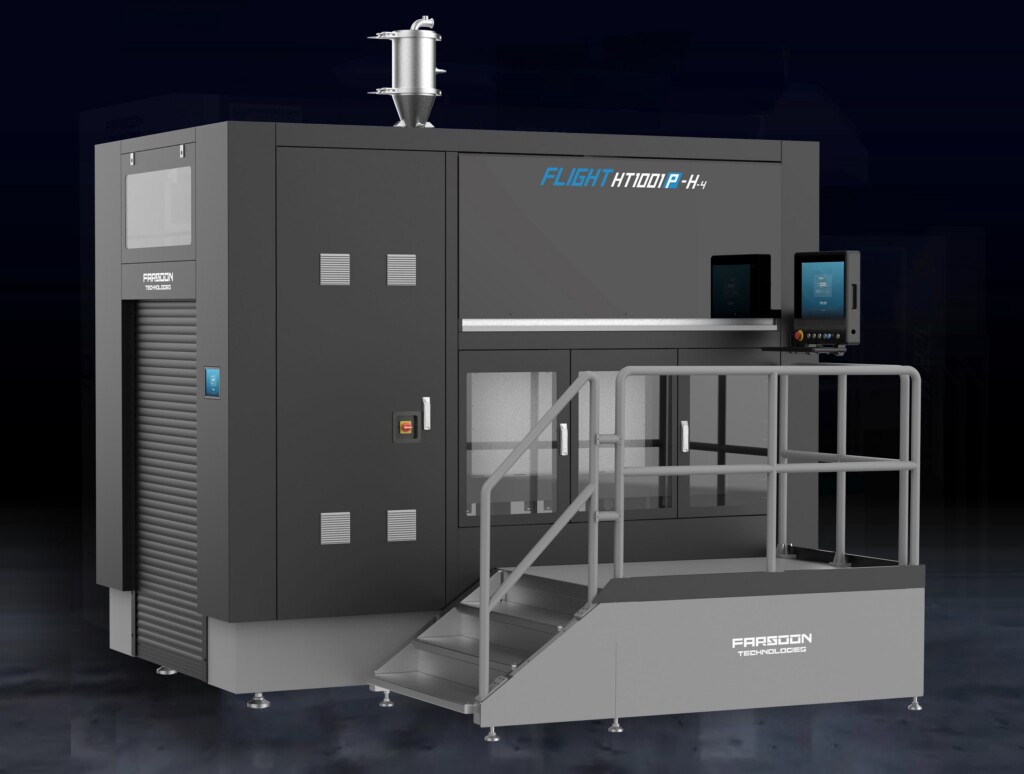
The Flight HT1002P-CAMS matters because it treats polymer powder bed fusion as an installed production line, not a standalone printer. Farsoon Technologies packages a 325-liter build envelope, four 300 W fiber lasers, thermal control, and the Continuous Additive Manufacturing Solution (CAMS) workflow into one machine. For APAC buyers, the value is operational: shorter idle periods, more predictable part rotation, and a route from prototype orders to qualified serial work.
What problem does the Flight HT1002P-CAMS solve?
It solves the gap between machine availability and factory flow. A printer can be productive while the plant loses hours waiting for preheat, cooling, powder handling, or part extraction. The platform extends the older 1001 and 1001-H line with an architecture that separates those tasks from the build station, giving operations a way to keep printing while non-print work happens elsewhere.
The commercial context also matters. Persistence Market Research estimates the global powder bed fusion market at US$4.3 Bn in 2026 and US$8.5 Bn by 2033, a 10.0% CAGR. For APAC manufacturers, that growth curve raises a practical question: will a shop run additive as a quoted project, or will it install repeatable cells and compete on cycle time?
Why large-format polymer PBF fails before the hardware is at fault
Most production stalls are ownership problems. If no process engineer owns the chamber temperature curve, powder reuse rule, and downstream inspection window, a bigger build chamber becomes a bigger source of scrap. Farsoon's HT1002P product page positions the machine around build consistency and modular workflow, which tells the buyer where the risk sits: not only in the laser set, but in the scheduling chain around it.
Multi-laser operation adds another caution. Peer-reviewed work on multi-laser powder bed fusion systems identifies residual stress, temperature gradients, and flow-path effects as issues when several energy sources work in the same chamber. The finding is broader than one material family, but the purchase lesson is the same: speed claims must be qualified by monitoring, cooling discipline, and a clear owner for the process window.
How the 1,000 × 500 × 650 mm build envelope changes part strategy
Build size is a scheduling tool. With a 1,000 × 500 × 650 mm envelope, the Flight HT1002P-CAMS can handle long one-piece parts or nested batches. The 1-meter axis suits ducts, interior trim, and industrial components; the 650 mm height gives room for taller parts or denser packing. In volume terms, the platform offers 325 liters, a figure that matters only when the factory can load parts into one thermal recipe.
For series production, part count per build and part consolidation become the decision points. A 325-liter chamber can raise the number of parts per build where design and qualification allow. If those parts need different cooling rules, the gain moves from the printer to the planner.
Do four 300 W fiber lasers beat CO₂-based polymer SLS?
They are designed to improve throughput, not to erase validation. The system uses four 300 W fiber lasers and can reach scanning speeds of up to 20 m/s, with the intent of raising output compared with conventional CO₂-based polymer SLS systems. The practical benefit comes from choosing a build approach that matches part quality and delivery pressure.
The system provides two operating modes.
| Mode | Scanning approach | Buyer meaning |
|---|---|---|
| Production Mode | Overlapping multi-laser scanning fields | Chase higher build speed and output |
| Premium Mode | Single-laser scanning within a 335 × 550 mm working zone | Hold tighter process control and certification requirements |
This split is useful for managers who need a simple rule: use the faster lane for validated repeat work, and reserve the controlled lane for qualification-sensitive parts.
What does thermal control add to production consistency?
The platform reaches a maximum chamber temperature of 220 °C. Multi-zone heating and infrared thermal monitoring support temperature consistency across the build area, while dynamic process adjustments and optical cooling reduce another source of drift. These features support consistency in large-format builds and repeated cycles; they do not replace polymer-grade validation. The buyer should test the exact material, thickness range, and cooling behavior before setting delivery promises.
Where modular CAMS creates real time gains
The value is not automation alone; it is the removal of forced waiting. The Continuous Additive Manufacturing Solution (CAMS) concept uses a bidirectional conveyor and electronic doors on both sides of the build station to load and extract build cartridges. Preheating, building, cooling, and breakout can be arranged separately, allowing production work to continue in one station while other stations prepare, cool, or unpack.
Farsoon says top rapid manufacturing players in China operate more than 100 polymer PBF systems, based on the company's 2026 serial-production release. That installation scale turns modular CAMS from a feature into a factory-architecture decision: multiple preheat and cooling units can sit beside a printer or be linked into centralized cells with automated guided vehicles or robotic arms.
Optional elements include:
- automatic laser window changers
- closed-loop powder supply and recycling
- manufacturing execution system integration
- remote monitoring
Availability depends on configuration and integration scope. For APAC buyers, this means the quotation should include station cycle time, cartridge handling, and MES data rules, not just laser count.
What APAC buyers should plan before buying
Regional service capacity is now part of the product. Farsoon expanded Australia/New Zealand coverage through a partnership with Emlogic announced in April 2026, and in July 2025 announced a Japan-focused cooperation with Solize Partners and Japan 3D Printer to advance large-format laser powder bed fusion applications. Those channel moves do not guarantee a successful line, but they reduce one common blocker: slow local diagnosis when a build fails.
For readers comparing additive paths inside one plant, our eight-laser metal PBF briefing provides a useful contrast: polymer serial work often wins on part variety and consolidation, while metal multi-laser projects often win on denser asset utilization in existing machining cells.
Action recommendations for a production-ready rollout
- Name one process owner before installation: who signs off temperature curves, powder reuse, inspection frequency, and stop criteria.
- Start with a part family, not a product SKU: pick components that share material grade, cooling time, and downstream finishing.
- Quantify non-print time: preheat, cooling, powder handling, extraction, and window cleaning should appear in the utilization model.
- Run both modes on the same qualification part, then compare defect rate, dimensional yield, and cycle variance.
- Link MES rules to the CAMS workflow: build order, cartridge status, powder lot, and operator sign-off need one traceable record.
- Use regional partner capacity as a procurement test: ask for response time, spare parts, and trained integration engineers in the target market.
FAQ: What changes when polymer PBF enters serial production?
Is the Flight HT1002P-CAMS only a faster polymer 3D printer?
No. The machine combines a 325-liter build volume, four 300 W fiber lasers, thermal control, and modular CAMS workflow options. Faster scanning is only one input; the production effect comes from keeping preheat, build, cooling, and breakout moving as separate steps.
When should a factory choose Premium Mode over Production Mode?
Use Premium Mode when certification, dimensional repeatability, or process-window control matters more than immediate throughput. The single-laser path within a 335 × 550 mm zone gives teams a tighter control setting for qualified parts.
Does a 1-meter build axis guarantee lower cost per part?
No. The 1-meter axis, together with 650 mm height, can support long parts or better nesting. Cost falls only when the plant can fill the chamber with compatible parts and reduce handoffs.
What is the first organizational change required?
Move additive from prototype ownership to production ownership. That means process engineering, planning, quality, and maintenance all share the same data and response chain.
References
- Farsoon: Flight HT1002P product announcement
- Farsoon: 100+ polymer PBF systems deployed
- Farsoon: Emlogic ANZ partnership
- Farsoon: Solize Partners, Japan 3D Printer, and Farsoon Technologies partnership
- Persistence Market Research: powder bed fusion market outlook
- 3D Printing in Medicine: multi-laser PBF process risks