
APACTechBriefing on APACTechDigit: Hy4 flash at 1/13 Cost — What APAC Buyers Should Measure
Same model, different wallet: a Jakarta startup feels Hy4 flash's cost cut on its monthly API bill, while a Tokyo enterprise feels it only after procurement clears data residency. Direct answer — Hunyuan team tuned Hy4 flash to score slightly above the larger Hy4 preview while cutting per-task cost to 1/13 of it; in APAC the real win comes from pairing that cheap inference with the right local channel.
By Leo Price, APAC tech observer (regionalist) — APACTechDigit / APACTechBriefing. Contact: contact@apactechdigit.com
Why did Hunyuan team rebuild Hy4 flash end to end?
The goal was to buy intelligence back at a fraction of the run cost. Rather than simply shrinking a model, Hunyuan team reworked four stages — pretraining, post-training, evaluation and inference — so the cheaper system would still produce work people can use. That four-stage chain is the part most short write-ups skip.
| Stage | What changed | Effect |
|---|---|---|
| Pretraining | Mixed attention, LatentMoE and Engram architecture features, backed by scaling-ladder experiments | KV cache compressed to 1/24 of Hy3 and 1/6 of Hy4, with quality held at target |
| Post-training | Self-distillation from Hy4, then reinforcement learning | End-to-end task output length cut by 50% |
| Evaluation | WorkIndex, an internal set built on typical WorkBuddy tasks, plus human review | Optimises finished work, single-turn length and end-to-end time, not public leaderboard scores |
| Inference | megakernel, 4-bit quantization and dflash | Decode speed above 150 tps, enabling low-cost, large-scale deployment |
Technical note: KV cache is the working memory a model holds while generating; shrinking it is what makes long, cheap runs feasible on modest hardware.
Is Hy4 flash really better, and how much cheaper?
Yes on measured quality, decisively on cost. On the internal WorkIndex measure, Hy4 flash edges above the larger Hy4 preview — 770B total parameters, 49B activated — while one task costs 1/13 of Hy4 preview, 1/20 of Hy4 and 1/8 of DeepSeek-V4.1-Flash-1027 (Max tier, busy-time price).
WorkIndex covers the artefacts knowledge workers actually ship: PPT creation and editing, document editing, spreadsheet repair, audio/video processing and visual understanding.
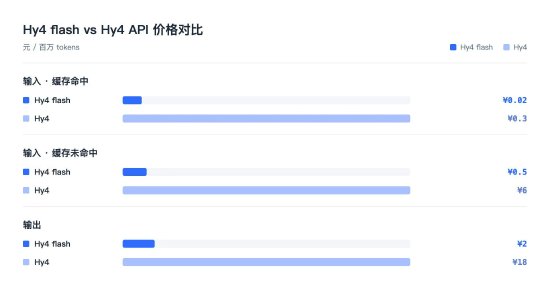
For readers who want the spec sheet behind the ratios, the official Hy4 flash research page lists 224B total parameters (including 64B Engram parameters), 12B activated per token, multimodal input and a 1M-token context window, with list API prices of ¥0.02 per million cached-input tokens, ¥0.5 per million ordinary input tokens and ¥2 per million output tokens. Keep the two lenses separate: that list price is metered per token, while the ratios above are measured per completed task.
Why does WorkIndex matter more to APAC enterprises than leaderboard scores?
Because it measures what a company actually pays for — finished work — instead of a benchmark number that can be optimised in isolation. This evaluation philosophy is the most under-reported part of the Hy4 flash story.
Hunyuan team states it deliberately centred WorkIndex on daily-work output quality, single-turn output length and end-to-end time, and set public leaderboard scores aside. For APAC buyers the practical consequence is clear: the number to scrutinise is completed tasks per dollar in your own workflow, not a rank on a general benchmark.
A Harvard Business Review analysis of US and Japanese AI adoption found the two markets struggle with different parts of adoption — further evidence that one benchmark cannot stand in for local workflow fit.
Where is Hy4 flash live, and what is free before November 30?
Distribution, as much as price, decides APAC reach. Hy4 flash is already live in Tencent Cloud TokenHub, WorkBuddy, Yuanbao, WeCom, QQ, ima and Marvis, with OpenRouter integration coming next.
Region note — WeCom is the enterprise messaging client many China-based and regional teams already work inside; Yuanbao is Tencent's consumer assistant; ima is a knowledge and reading tool. Shipping inside those shells lets a team in Jakarta or Kuala Lumpur try the model without changing tools, which is often the difference between a pilot and a purchase.
Promotion window: until November 30, WorkBuddy offers Hy4 flash free for a limited time, and the Tencent Cloud TokenHub API runs at 50% off. Both are time-boxed, so any cost model built on promotional pricing should be rechecked once the window closes.
What is the real APAC cost equation — and where does a cheap model still lose?
Cheap tokens are necessary but not sufficient. In APAC, data residency, hybrid deployment and inference volume frequently dominate the final bill, which is why the same 1/13 ratio can be transformative in one market and beside the point in another.
IDC figures cited in regional research put Asia-Pacific AI and generative-AI spending (including China and Japan) rising from about $121.5 billion in 2025 to $555.2 billion by 2030, a 35.5% CAGR, with Japan the fastest-growing market at 39.8%. Info-Tech Research Group's CIO Priorities 2026 likewise framed APAC IT leadership around AI value, cost sensitivity and accountability. On the ground, Lenovo's APAC leadership says the mix is shifting from building models to running them: Sumir Bhatia, president of Lenovo's Infrastructure Solutions Group for APAC, warned that failing to plan inference cost 'can be harmful', because inference can run up to 15 times training cost across a model's lifecycle, while Nigel Lee, Lenovo's Singapore managing director, tied ASEAN hybrid-AI demand to security and regulatory requirements. Lenovo's regional work also reports 86% of APAC organisations opting for hybrid AI to keep some workloads on-premise or at the edge for data sovereignty (Lenovo APAC outlook).
This is the same discipline we bring to what APAC buyers should decide in open-model procurement: price is an input, not the verdict. A low token price should be read like an Asia-Pacific buyer reads any launch price — against local channels, taxes and support — before it becomes a migration plan.
Risk note: the headline ratios come from an internal WorkIndex tuned to WorkBuddy task types. If your workload sits outside PPT, documents, spreadsheets, audio/video and visual understanding, treat 1/13 as directional rather than contractual.
FAQ: Hy4 flash for APAC teams
Is Hy4 flash free, and until when?
WorkBuddy offers it free for a limited time until November 30, and the Tencent Cloud TokenHub API is at 50% off in the same window. OpenRouter access is announced but not yet live.
How much cheaper is it than Hy4 and its rivals?
Per WorkIndex: 1/13 of Hy4 preview, 1/20 of Hy4 and 1/8 of DeepSeek-V4.1-Flash-1027 at its Max tier, busy-time price.
Does the lower price mean lower quality?
No. Hunyuan team reports slightly better overall results than Hy4 preview (770B total, 49B activated), achieved through the four-stage optimisation chain and WorkIndex-tuned evaluation.
Should a regulated APAC company switch now?
Only after a local pilot. Data-residency and hybrid requirements can outweigh token savings, and promotional pricing expires on November 30.
Localization checklist for APAC teams
- Map your top three daily tasks to WorkIndex categories before trusting the 1/13 figure.
- Recalculate unit economics after the November 30 free and 50% off window closes.
- Confirm data residency; keep regulated workloads hybrid or on-premise even when the API is cheaper.
- Pilot inside WeCom, Yuanbao or WorkBuddy first, before changing the wider toolchain.
- Brief local teams on the terms: WeCom = enterprise messaging, Yuanbao = consumer assistant, ima = knowledge tool, OpenRouter = model router.
- Add a multilingual and 1M-context test for APAC documents before rollout.
Reference sources
- Hunyuan — Hy4 flash research page (official architecture and API pricing)
- IDC figures via Guoyuan Securities research note (APAC AI spend forecast)
- Lenovo APAC AI investment outlook (hybrid adoption, executive comments)
- Harvard Business Review — US vs Japan AI adoption
- Info-Tech Research Group — CIO Priorities 2026 APAC