
APACTechDigit / APACTechBriefing: RTX 5090 at $6,599.99 on Newegg vs. Japan's 22% Slide — A Cross-Region Buyer's Verdict
Same silicon, three very different price tags. On Newegg the self-sold RTX 5090 floor sits at $6,599.99 — roughly 3.3x NVIDIA's $1,999 MSRP — while Japanese stores cut the card by as much as 22.38% this week and the China market heads the other way with a new RTX 50 series hike this month. The verdict for APAC buyers: choose by region first, by model second.
What exactly did Newegg restock, and at what price?
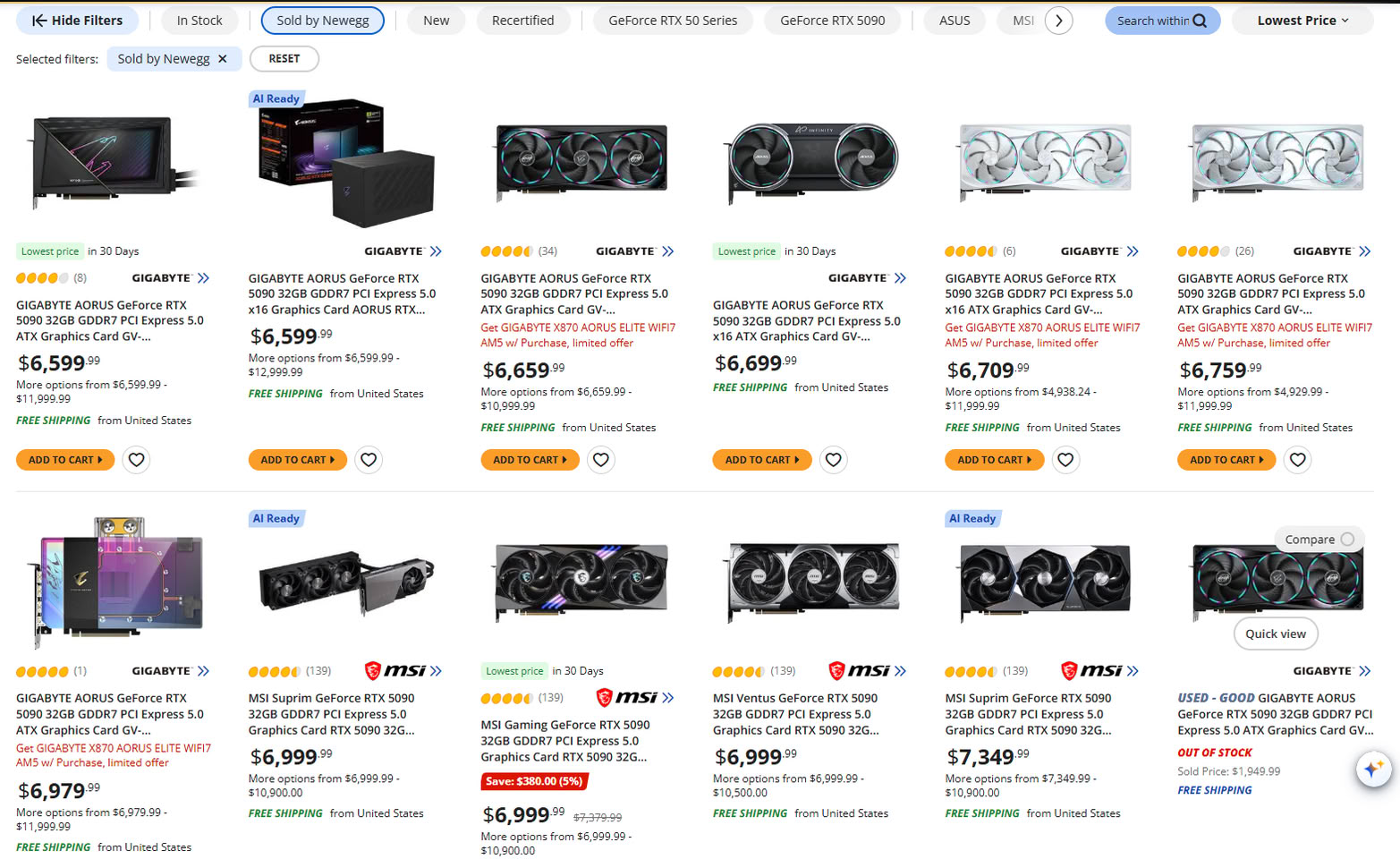
Conclusion: this is a first-party restock, not a marketplace free-for-all. Per Newegg's current listings, the cheapest self-sold RTX 5090 is the GIGABYTE AORUS RTX 5090 Xtreme Waterforce at $6,599.99 — about 3.3 times the $1,999 official price NVIDIA set. Every card in the batch is sold by Newegg directly, not by third-party sellers.
| Model (Newegg first-party) | Listed price | Read |
|---|---|---|
| GIGABYTE AORUS RTX 5090 Xtreme Waterforce | $6,599.99 | Lowest current floor |
| GIGABYTE AORUS Master ICE | $6,759.99 | Next step up |
| MSI Gaming Trio OC / Ventus 3X OC / Suprim Liquid SOC | $6,999.99 each | Uniform MSRP+ pricing |
| ASUS ROG Astral RTX 5090 OC | $6,249.99 then $9,490 | Sold out fast, relisted higher |
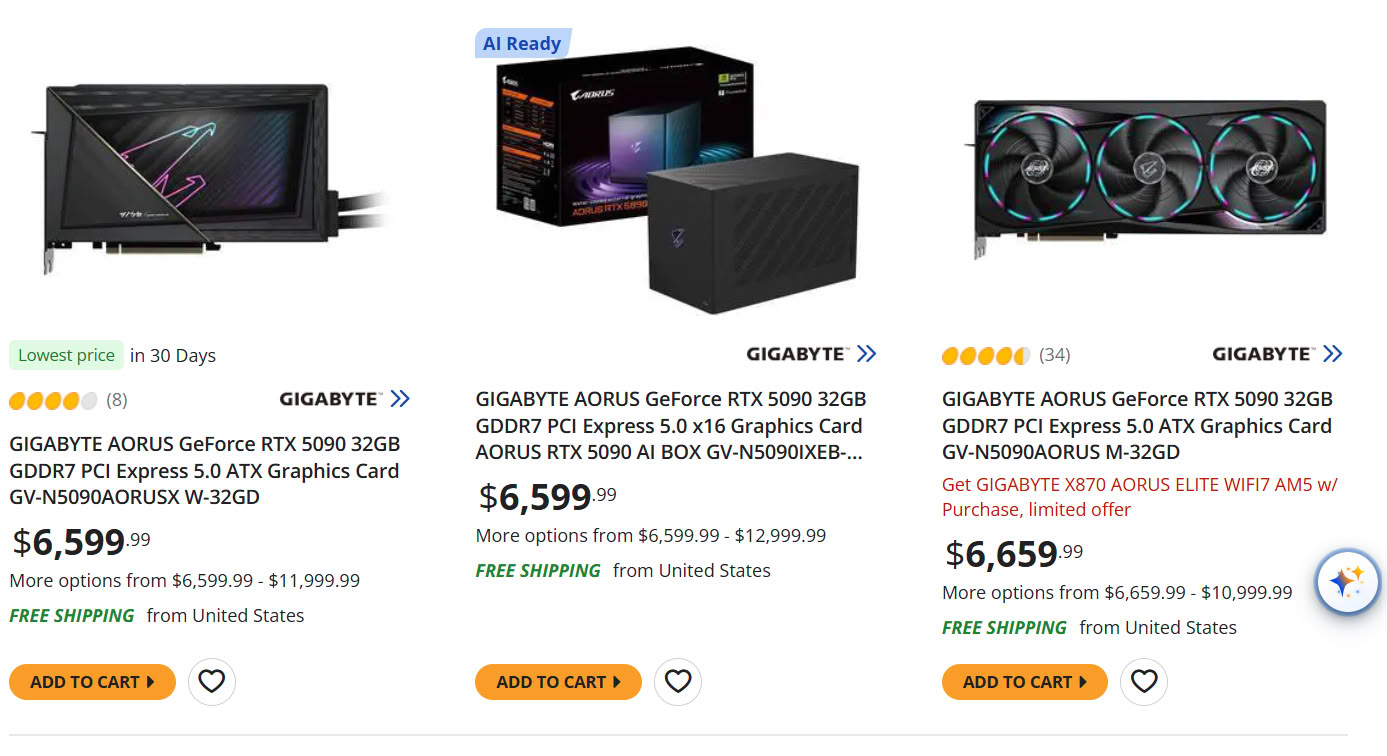
Beyond that floor, GIGABYTE's AORUS Master ICE lists at $6,759.99, while MSI's Gaming Trio OC, Ventus 3X OC and Suprim Liquid SOC models are all marked at $6,999.99. The ASUS ROG Astral RTX 5090 OC is the volatility marker: it appeared at $6,249.99 and was snapped up almost immediately, and the same card now shows $9,490. Compared with several weeks ago these numbers have eased — but "eased" is doing heavy lifting, because the absolute levels remain extraordinary.
Why is the US price near 3.3x MSRP while Japan just dropped 22%?
Conclusion: the divergence is inventory timing, not a change in NVIDIA's list price. On November 15, Japanese retail data showed RTX 5090 prices falling as much as 22.38%: the Palit GeForce RTX 5090 GameRock 32GB went from ¥1.288 million at Dospara to ¥1.048 million, then ¥999,800 across Akihabara shops. RTX 5080 fell from ¥359,800 to ¥299,800, roughly 16.7%. Local outlet Gazlog, cited in that coverage, tied the move to late-October price peaks and a fresh early-November restock rather than any management change.
But a local drop is not a regional reset. TechPowerUp's October index, published November 3, put the RTX 5090 at 262% above its $1,999 MSRP across 10 countries, with a global average near $7,240 and GPU prices up 35% in three months. TechSpot's survey of the US market this October found the cheapest spot card at about $9,400 and many models above $11,000 — several weeks ago, before this restock. Against that backdrop, $6,599.99 reads as an improvement rather than a bargain.
Supply explains the stickiness. In early this October, leakers said NVIDIA had cut or halted GB202 allocation to the RTX 5090 line in favor of RTX PRO workstation cards; Micro Center then removed the model from its catalog, sparking discontinuation talk. NVIDIA publicly denied a stop while conceding tight supply, and an unnamed partner said the GB202-plus-GDDR7 combination can no longer be ordered the old way. That input pressure is the same memory-cost squeeze already reshaping Asia-Pacific hardware decisions; the global market has not decoupled from it.
RTX 5090 vs. RTX 5080: which trade-off fits APAC budgets?
Conclusion: for most APAC buyers the RTX 5080 is the rational pick and the 5090 a scarcity purchase. Industry observers note the RTX 5080 costs only a fraction of the flagship — a gap that matters far more when the 5090 floor is $6,599.99 and Japan's RTX 5080 has already corrected to ¥299,800.
| Decision factor | RTX 5090 | RTX 5080 |
|---|---|---|
| Street price | $6,599.99 and up on Newegg; $9,490 for one ASUS card | A fraction of the flagship; ¥299,800 in Japan after the cut |
| Availability | Sporadic restocks, sold out fast | Steadier retail flow |
| Best fit | Heavy AI and workstation workloads | Gaming and mainstream content work |
| Principal risk | GB202 and GDDR7 supply, hikes this month | Less exposure to flagship scarcity |
What should APAC buyers and IT teams do now?
Conclusion: treat this as a regional procurement problem, not a single global SKU decision. The same card is falling in Akihabara, scarce on Newegg, and heading up in China this month. A practical checklist:
- Benchmark against the $1,999 MSRP, not the sticker — roughly 3.3x is the current US floor, not a discount.
- Watch regional clocks: Japanese store-level drops of up to 22.38% can precede wider corrections, while the US market and China market move on different timelines.
- Verify seller type — Newegg's batch is first-party, which changes warranty and return terms versus marketplace listings.
- Track GB202 and GDDR7 supply notes; NVIDIA's denial of a stop does not mean easy availability.
- Set a real threshold: for most teams the RTX 5080 clears the work at a fraction of the cost.
- Budget for adjacent costs — the broader storage cost reset can outweigh the GPU delta in a full workstation build.
FAQ: the RTX 5090 questions APAC buyers keep asking
Is the RTX 5090 discontinued?
No. NVIDIA denied discontinuation while acknowledging tight supply; Micro Center's catalog removal and the GB202-to-RTX PRO shift fed the rumor in early this October.
Why is Newegg's cheapest card $6,599.99 rather than $1,999?
Because supply, not MSRP, sets street price: GB202 and GDDR7 shortages plus RTX PRO priority pushed the US first-party floor to about 3.3x the $1,999 MSRP.
Are prices finally falling across the region?
Only locally. Japan saw up to 22.38% off this week, but the global market average sat about 262% above MSRP in the October index, and China's partners plan a hike this month.
Should we buy the RTX 5090 or wait for the RTX 5080?
For most gamers and mainstream teams, the RTX 5080 — priced at a fraction of the flagship — is the more realistic choice while flagship stock stays thin.
Reference sources
- TechSpot — US market spot-price survey, this October (as cited in the source reporting).
- TechPowerUp, "GPU Prices Up Again in October," November 3, 2026.
- ZOL, Japan RTX 5090/5080 price correction, November 15–16, 2026.
- TweakTown, Japan price cuts up to 22%, November 16, 2026.
Author: Leo Price — APAC Tech Observer, Regional Desk, APACTechDigit / APACTechBriefing.