
APACTechBriefing Case Review: Nuvoton's Gerda IC and Qt for MCUs Drop External Memory From APAC's Price-Sensitive Panels
Can a vehicle cluster or an appliance panel run fluid graphics with no external memory chip at all? With Nuvoton's Gerda IC paired with Qt for MCUs, yes — and in Asia-Pacific the payoff gets decided market by market, not in one reference design. The same TFT cluster that penciled out on a Japanese appliance line dies in an Indonesian commuter-scooter quote until the external DRAM line disappears from the BOM. This case read covers the market, the regional gaps, the build, and the lessons worth copying.
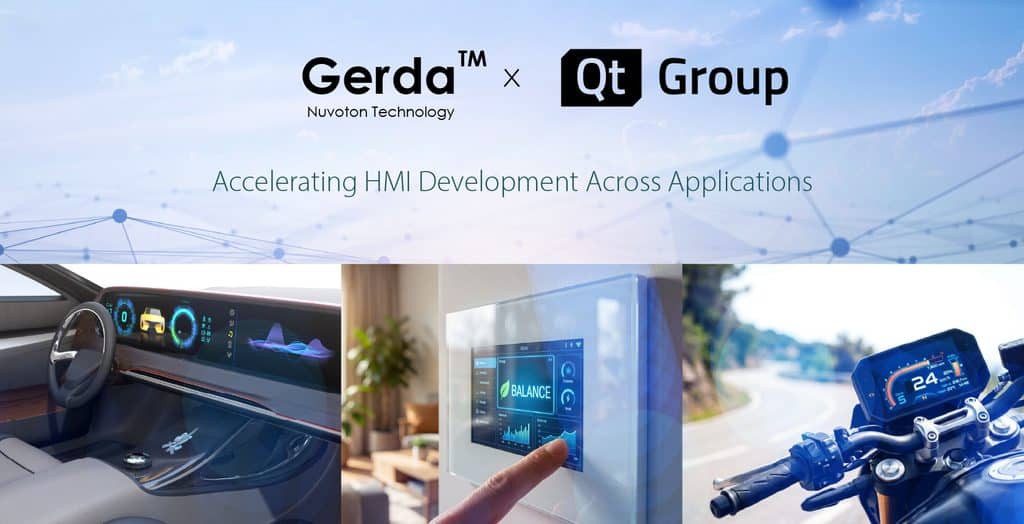
Nuvoton's Gerda IC and Qt for MCUs Bring Premium User Interfaces to Cost-Efficient Products Without External Memory.
Why does the two-wheeler cluster market force this decision now?
Conclusion first: the volume sits in APAC, the margin pressure sits in APAC, so the memory cost question gets answered in APAC. India is the world's largest two-wheeler market, and riders there are adopting TFT clusters quickly for navigation prompts and call alerts, according to Mordor Intelligence, which pegs India's two-wheeler output at 26.69 million units for FY2025-26. Worldwide, Persistence Market Research values the motorcycle instrument cluster market at about US$3.0 billion in 2026, reaching US$3.9 billion by 2033 — a modest 3.9% CAGR that hides the real story: the analog-to-digital mix shift, where a full-digital cluster can cost 3-4 times an analog unit, per Market Reports World. In that mix, every component deleted from the board is margin kept. (BOM = bill of materials, the per-unit parts cost.)
Where do APAC markets diverge on the same panel problem?
Same TFT panel, three different economics. Japan's appliance majors treat the washing-machine UI as a service surface — OTA (over-the-air updates) and long-life security matter more than the last yen of BOM. India's two-wheeler OEMs quote against analog clusters, so a digital twin must land near the analog price band or the program dies in sourcing. Indonesia and Vietnam split the difference: commuter scooters demand the low BOM, while financing and service ecosystems increasingly expect connected features. It is the same pattern we flagged when arguing why TSMC should keep 3D DRAM outside the foundry and sell system co-engineering instead: the winning design matches local price and service reality, not the vendor's home-market spec.
| Segment | Anchor markets | Binding constraint | What no-external-memory buys |
|---|---|---|---|
| 4W cluster / HUD | Japan, Korea, India premium tiers | ASIL-B functional safety plus security | Fewer parts, cleaner safety case |
| 2W cluster | India, Indonesia, Vietnam | BOM ceiling set by analog quote | DRAM and PCB area deleted at millions of units |
| Appliance UI | Japan, China | OTA and service life | Lower system cost, security-backed updates |
What did NTCJ and Qt Group actually build?
Conclusion first: a target-hardware integration that turns Gerda into a first-class platform for Qt for MCUs. On November 5, 2026, Nuvoton Technology Corporation Japan (NTCJ) and Qt Group announced that Nuvoton's Gerda HMI controller platform is now supported as target hardware for Qt for MCUs; the release, datelined Kyoto and Espoo, moved on the AP News wire the same day — a Japan-silicon, Finland-software pairing aimed squarely at cost-efficient products.
The mechanics are concrete. Gerda's large internal RAM, together with its display, connectivity and control interfaces, allows standalone HMI designs with no external memory. Qt for MCUs contributes the graphics engine, a component library and a development environment; its optimized rendering rides Gerda's texture compression to shrink the memory needed when graphics and animation run. The silicon is documented, not marketing shorthand: Qt's board-support notes for the Gerda-4UL target list an Arm Cortex-M33 at 400MHz with 3.5MB of VRAM driving a WVGA 800x480 panel, while Nuvoton's Gerda-4L series page pairs an Arm Cortex-M7 with 5MB/6MB built-in RAM carrying an image-compression function. Nuvoton's own HMI materials state that the large built-in RAM removes the need for external DRAM, simplifying the design and cutting BOM cost.
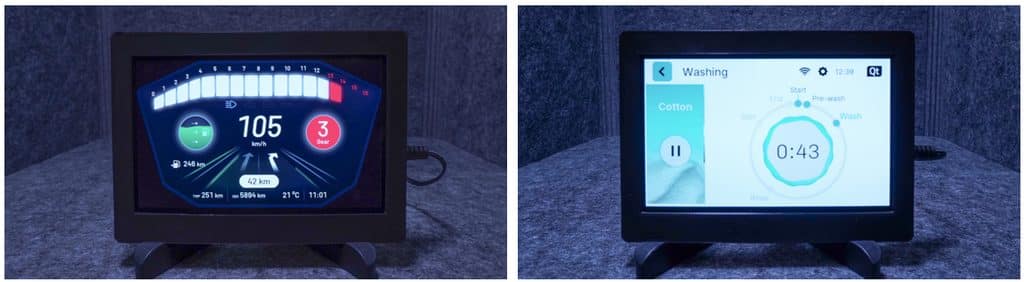
Demo of motorcycle instrument cluster (left) and a home appliance washing machine UI (right) running on the Nuvoton's Gerda IC and Qt for MCUs.
The timeline matters for planners. Nuvoton began mass production of its fourth-generation Gerda lineup (4M, 4L, 4C) in May 2025, and the Qt target support landed roughly eighteen months later. Ecosystem bring-up, not silicon availability, is the gating item — budget that lag into any adoption plan.
What changed on the BOM and the roadmap?
Three outcomes worth recording in the case file:
- Standalone HMI becomes a buildable configuration: fewer components and less board area, cost relief that compounds in high-volume products — the exact math India and Southeast Asia volumes reward.
- Resolution climbs without DRAM: Nuvoton says Gerda-4L's dedicated compression engine renders WXGA at 60FPS using half the memory, from embedded RAM alone.
- OTA and security stay on the table: the combined solution supports OTA updates, and Gen-4 parts add ASIL-B functional safety, an EVITA-Full HSM and secure boot, with NTCJ describing itself as the first Japanese semiconductor company running an ISO/SAE 21434 TüV-certified process per its June 2025 announcement.
The move also rhymes with a wider APAC shift toward moving memory into the silicon itself — DeepX's LPDDR5x-PIM edge AI chip is the compute-side twin of Gerda's graphics-side play. Panel programs still budgeting external DRAM by default are carrying dead cost.
Yoshihide Kanakubo, Vice President, Battery and Automotive BG, Nuvoton, frames the value: "By combining Gerda with Qt for MCUs, customers can deliver premium graphical user experiences while balancing performance, memory efficiency, and system cost."
The quieter result is development speed. Qt for MCUs ships pre-built components, the QML language for describing the UI, plus simulation and AI-driven tooling that cut effort — meaningful where cluster programs now follow model-year refresh cadences set in Delhi and Jakarta rather than Tokyo.
Which lessons transfer to the next APAC panel program?
Case verdict: the no-external-memory configuration is worth piloting wherever unit volumes are high and the price ceiling is set by an analog incumbent — 2W clusters in South and Southeast Asia first, appliance panels second, premium 4W clusters as a safety-consolidation play rather than a cost play. Four transferable lessons:
- Ecosystem lag beats silicon schedules: plan for the eighteen-month gap pattern between chip production and toolchain support.
- Resolution targets are regional: WVGA-class suits commuter 2W; WXGA claims only hold where the compression engine is in the part.
- Security is the OTA license: without HSM-backed secure boot, connected-vehicle, 2 Wheeler and appliance ambitions stall at fleet pilots.
- Quote against the analog incumbent, not the digital peer set — that is the comparison your sourcing team actually faces.
The APAC localization checklist for memory-light HMI
- Price the deletion: quantify DRAM, PCB area and assembly savings per unit at your actual APAC volume before committing.
- Set resolution by segment: WVGA 800x480 for commuter two-wheelers; WXGA@60FPS only where the compression engine ships in the part.
- Match security to connectivity: no OTA plans, no need to over-spec; connected scooters or appliances mean insisting on HSM-backed secure boot.
- Scope functional safety: ASIL-B matters for 4W clusters and HUDs; do not pay for it on a washing machine.
- Reuse before you render: start from Qt for MCUs pre-built components and QML, then use simulation and AI tooling to compress the schedule.
- Localize the surface, not just the string table: sunlight readability for Indian daytime riding, service-center workflows for Indonesia, OTA cadence aligned to Japanese appliance lifecycles.
APACTechBriefing FAQ
Does dropping external memory really move a two-wheeler BOM?
At 26.69 million units of annual India output, per-unit savings compound fast, and on price bands set by analog incumbents, component deletion often decides whether a digital cluster program survives sourcing review. Treat the exact figure as program-specific: it depends on panel size and DRAM pricing at your quote date.
Which Gerda hardware is supported today?
Nuvoton's Gerda HMI controller platform is supported as Qt for MCUs target hardware. Qt publishes board-support instructions for the Gerda-4UL (Cortex-M33 at 400MHz, 3.5MB VRAM), and Nuvoton's Gen-4 lineup spans Gerda-4M, 4L and 4C in mass production since May 2025.
Can OTA updates run without external memory?
Yes. The combined solution supports OTA, with Gerda's security features — including an EVITA-Full HSM and secure boot on Gen-4 parts — backing the update path for connected vehicles, two-wheelers and home appliances.
What display specs are realistic without DRAM?
Qt's documented Gerda-4UL target runs a WVGA 800x480 panel, and Nuvoton claims WXGA at 60FPS on Gerda-4L using its compression engine with embedded memory only. Anything higher should be validated per panel before commitment.
Sources
- PR Newswire (Nov 5, 2026): Nuvoton's Gerda IC and Qt for MCUs Bring Premium User Interfaces to Cost-Efficient Products Without External Memory — https://www.prnewswire.com/news-releases/nuvotons-gerda-tm-ic-and-qt-for-mcus-bring-premium-user-interfaces-to-cost-efficient-products-without-external-memory-302930093.html
- AP News (Nov 5, 2026): same release, Kyoto/Espoo dateline — https://apnews.com/press-release/pr-newswire/press-release-e66ba561d6a7b6ca5f4ea720c152f405
- Qt for MCUs 2.12.3 documentation: Nuvoton Gerda-4UL Board instructions — https://doc.qt.io/QtForMCUs/qtul-instructions-gerda-4ul.html
- Nuvoton: Gerda-4L Series product page — https://www.nuvoton.com/products/dsp-isps/hmi-for-automotive-gerda/gerda-4l-series/
- Nuvoton: HMI Solutions landing page — https://www.nuvoton.com/landing/automotive/hmi-solutions.html
- Nuvoton Gen-4 Gerda announcement, June 2025 (PR Newswire Asia) — https://cnmobile.prnasia.com/story/492310-1.shtml
- Mordor Intelligence: Automotive Instrument Cluster Market — https://www.mordorintelligence.com/industry-reports/global-automotive-instrument-cluster-market
- Persistence Market Research: Motorcycle Instrument Cluster Market — https://www.persistencemarketresearch.com/market-research/motorcycle-instrument-cluster-market.asp
By Ethan Rivera, APACTechDigit | APACTechBriefing. Program data and tips: contact@apactechdigit.com