
Rapidus's 2nm Window Is Closing: What the SRAM and Cleanroom Setbacks Mean for Asia-Pacific Buyers | APACTechBriefing
Rapidus has still not produced a working SRAM cell — the gate any team must clear before volume production — and its target of closing that gap before summer 2026 has slipped, leaving the 2nm start planned for the second half of fiscal 2027 under real pressure. Dust and particle control inside the cleanroom at the IIM-1 fab in Chitose, Hokkaido is the second bottleneck. My read: this is less a science problem than an execution and sequencing problem.
In every hardware programme I have reviewed that missed a ship date, the post-mortem said the same thing: the roadmap was approved as if engineering, facility qualification and customer design-in could run in parallel with no slack. Rapidus is now the case study.
What exactly is stuck, and how far behind is it?
Conclusion first: two independent blockers are setting the clock, and neither is a small fix. The first is silicon-devices readiness, the second is fab operations hygiene.
On the first, Rapidus had set itself the milestone of completing a functional SRAM cell before summer 2026. As of now that target is unmet, and reporting on the Bloomberg account of 10 November 2026 puts the project several months behind plan, with people familiar with the matter saying the company may ultimately get there but only after some years of delay. The consequence is arithmetic, not opinion: if the gap is not closed, the volume start scheduled for the second half of fiscal 2027 — the October 2027 to March 2028 window — is at risk, and the 2028 full-ramp assumptions built on top of it move with it.
On the second, the company is also working through contamination problems: particulate and dust control inside the cleanroom. Engineers are treating it as a priority item alongside SRAM.
- Gate 1 — SRAM cell: target before summer 2026; not achieved as of now; months of schedule debt.
- Gate 2 — particle control: live issue at IIM-1; directly feeds yield and ramp speed.
- Gate 3 — customer confidence: the company has not disclosed technical detail, which forces buyers to plan on assumption rather than evidence.
Why an SRAM cell and a speck of dust decide a fab's credibility
Short answer: SRAM is the industry's honesty test, and particles are the bill that arrives later.
SRAM sits at the tightest repetition in a logic process — six transistors per bit, packed at the minimum pitch the lithography stack can hold. If a node can print, connect and retain a working SRAM bit, most other blocks follow; if it cannot, the node is not ready for volume. For AI accelerators this is not academic: on-chip SRAM cache determines how much data an accelerator can serve without paying the energy tax of fetching from external memory, which is why capacity per square millimetre is a commercial specification, not a lab curiosity.
Contamination is the same story in operational dress. At this node class, a single stray particle can kill a cell that has already absorbed hundreds of process steps. Yield is not a quality metric here; it is the unit-cost curve. A fab that cannot hold particle counts steady cannot promise a price, a delivery date, or a margin.
Is this an engineering problem or an organisational one?
I would put most of the weight on organisation. Look at the compression of the schedule itself: the first EUV exposure tool reached Chitose in December 2024, trial production and the 2nm gate-all-around test-chip work followed in 2025, and the process design kit was put in front of lead customers on a Q1 2026 cadence. In January 2025, president Atsuyoshi Koike told Digitimes that the initial yield target for the trial was 50%, with the ultimate goal of 80–90%. Those are not incremental numbers. They describe a programme that assumed device development, facility qualification, tool acceptance and design enablement could all be finished in one overlapping motion.
That is the classic failure pattern: a milestone approved by a board, but no single owner accountable for the handoff between the device team and the fab. Missing SRAM and missing particle counts are two symptoms of one condition — a site still learning how to run yield as a shared, cross-team discipline rather than two separate queues.
How much public money is behind the bet, and what does delay cost?
Rapidus was established in 2022, driven by the Japanese government and backed by a broad industrial consortium, and is treated as the centrepiece of Japan's attempt to rebuild leading-edge logic manufacturing. Support from the government has already exceeded JPY 2 trillion. That figure is not static: an additional JPY 631.5 billion (roughly USD 4 billion) was approved in April 2026, lifting cumulative research and development assistance to JPY 2.354 trillion, as Reuters reported. Private-side capital is also being added in tranches — a JPY 267.6 billion round completed in February 2026 and a further JPY 150 billion from the Investment Program Association in June 2026, taking total funding to JPY 424.95 billion, per company announcements.
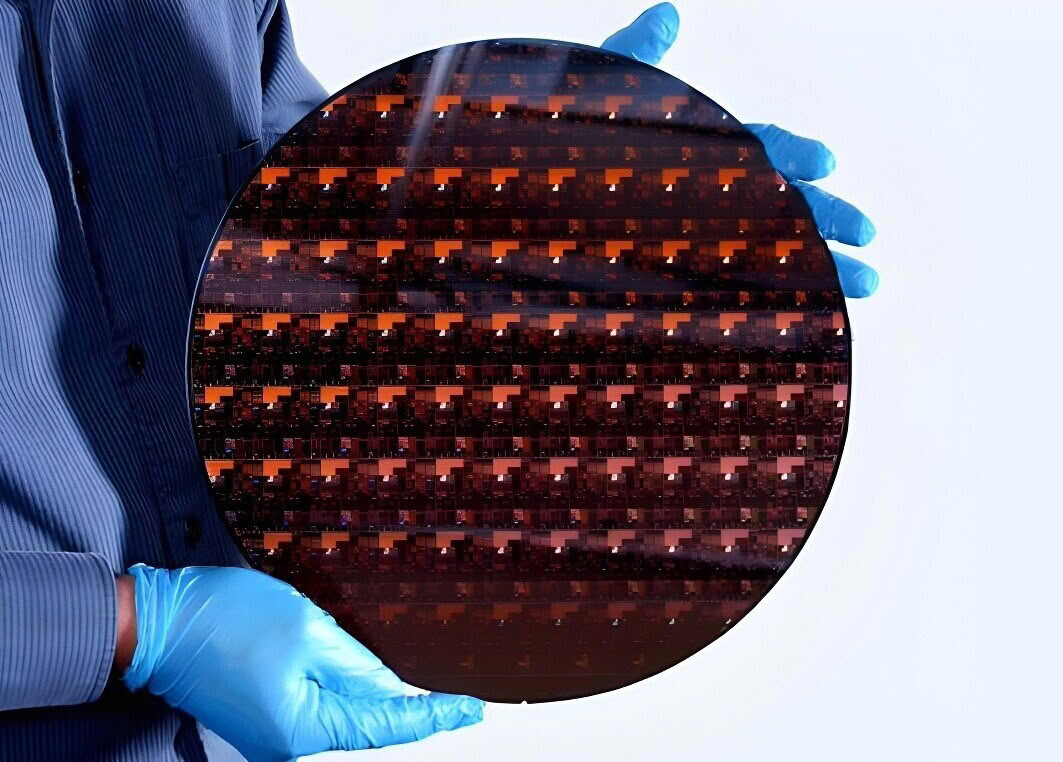
The exposure is symmetrical. A large slip does not only hurt a schedule; it invites conditionality on subsidies, pressures the listing ambition the company has set for before 2032, and gives taxpayers' representatives a reason to ask whether the next tranche should be milestone-gated. Politically, Japan's broader ambition — an increase in annual sales of domestically made chips to JPY 40 trillion by 2040, from roughly JPY 8 trillion today, as Reuters has reported — is a long game, so one delayed fab will not end it. But budget patience is finite and visible.
Where Asia-Pacific buyers actually feel the slip
Leading-edge demand is not the question. Our briefing on iPhone 18's 2nm chip and price pressure tracks consumer programmes already scheduled onto this class of node, and the compute checklist we built from the DeepSeek V5 and Ascend 950 training report is the same story from the accelerator side. The question is supply geography.
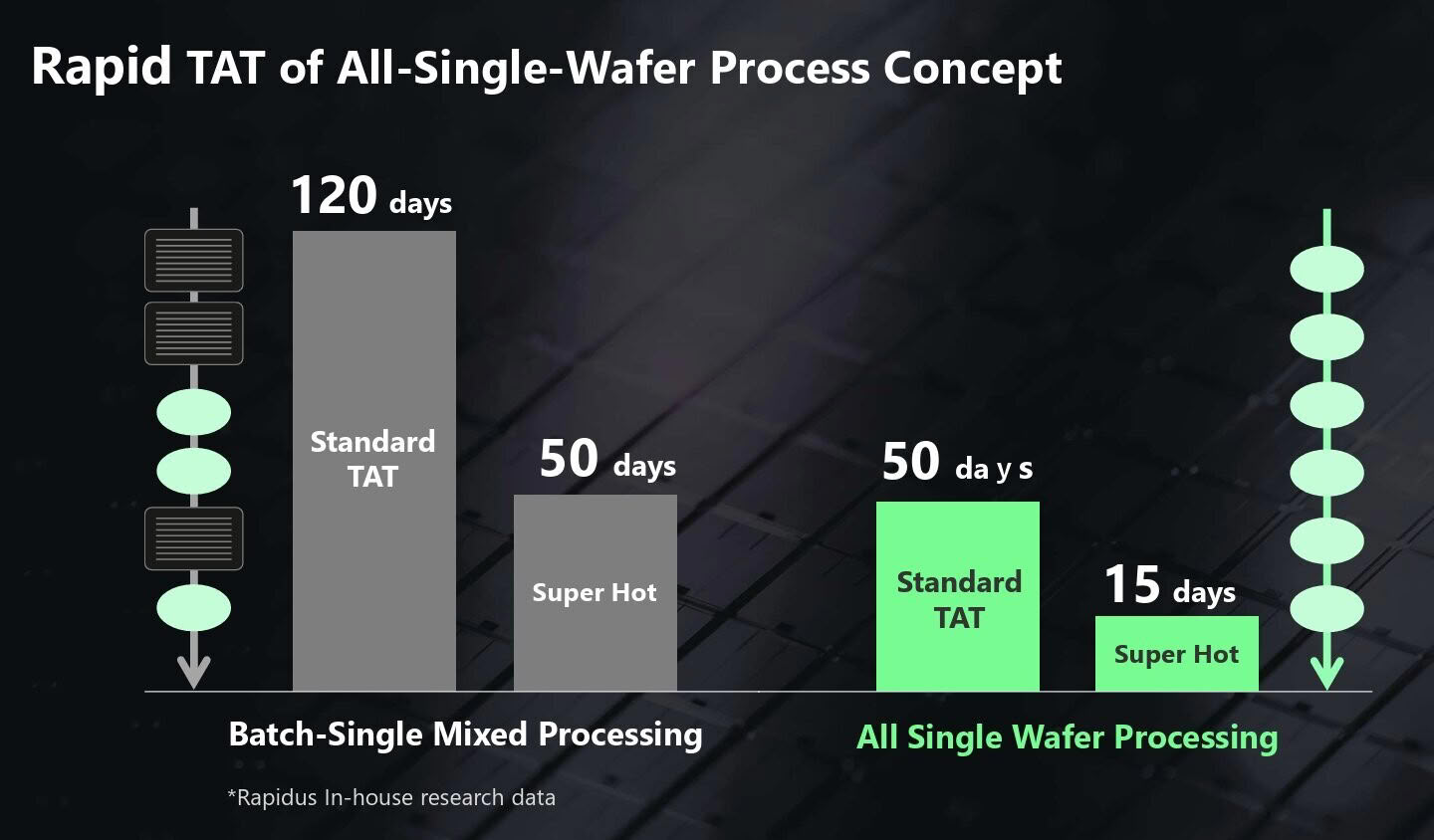
That is the difference the market already prices. To compete, Rapidus has been pitching differentiated services, including an unusually fast wafer turnaround commitment rarely seen in the foundry business, aiming at customers who need advanced nodes on short loops. Industry voices, however, judge the offer on one variable only: whether the current technical blockers are cleared on time and 2nm volume is reached.
| Dimension | Rapidus (IIM-1, Chitose) | Incumbent benchmark (TSMC N2) |
|---|---|---|
| Node status as of now | SRAM cell incomplete; 2nm volume targeted for the second half of fiscal 2027 | Volume production of N2 started in the fourth quarter of 2025, per TSMC's technology page |
| Full-capacity scale | Roughly 25,000–30,000 wafers per month targeted | Advanced fabs running above 100,000 wafers per month |
| Lead time promise | Ultra-fast turnaround as the differentiator | Queue-limited allocation; reported booked capacity for 2026 |
| Value to APAC buyers | Genuine second-source option, if it ships | Default source for consumer and AI silicon |
Read regionally: every quarter Rapidus slips is a quarter in which Asia-Pacific procurement teams keep a single-point dependency for advanced logic, and Japanese equipment and materials suppliers keep a flagship domestic customer out of their order book. Over the past few years, the Chitose site progressed fast enough — cleanroom deployment in a short build window, more than 200 advanced semiconductor tools installed, and a 2nm gate-all-around test chip taped out in 2025 — to make it the quickest-moving advanced fab project globally. Speed was the selling point; speed is now the risk.
What has to change before the 2027 window shuts
The company maintains that the programme is still moving and that the team will push for the agreed start of volume production in the second half of fiscal 2027, while declining to publish technical specifics. If that stance holds, here is the sequence I would expect a credible recovery plan to follow.
- Close SRAM as a dated, externally verifiable gate, not a status update — the customer base is entitled to proof, and proof is what unlocks design commitments.
- Name one accountable owner for yield across device and fab, instead of letting two teams hand problems to each other at interfaces.
- Instrument the cleanroom publicly: particle excursion tracking, tool acceptance records and qualification cadence are the numbers buyers underwrite against.
- Convert the turnaround promise into contractual terms with penalty logic, so fast cycle time becomes a spec rather than a slogan.
- Gate public funding on evidence: milestone-linked tranches protect the programme from a political reset if the timetable moves again.
- Lean on the partner base — the IBM-centred advanced-node collaboration and the chiplet, packaging and integration work approved under NEDO's fiscal 2026 plan — rather than rebuilding everything in-house.
If contamination and SRAM issues persist, the 2nm timetable will absorb further damage. But sustained government backing and the partner network mean the outcome is a delayed entry, not necessarily a failed one, and the company still has a realistic path to overcome the current difficulties and move toward its stated target.
FAQ: the questions APAC technology leads are asking
Has Rapidus abandoned its 2nm production target?
No. The company says it remains fully committed to starting volume production in the second half of fiscal 2027 (October 2027 to March 2028). What has changed is the credibility of that date, because the SRAM milestone set for before summer 2026 is still open as of now.
Should Asia-Pacific buyers change their sourcing plans today?
Not on this news alone. Treat Rapidus as a qualification candidate, not an assumption. Keep allocation with existing suppliers for 2027–2028 volumes and open a second-source track that can be converted if a working SRAM result and stable particle control are demonstrated.
Why does the cleanroom matter to a chip designer?
Because it converts directly into cost per good die. Contamination losses at leading-edge nodes are absorbed by pricing and delivery commitments, so a site fighting particle problems is a site that will renegotiate your schedule.
Is Japan's semiconductor strategy in jeopardy?
One delayed fab does not reverse the direction. Support has exceeded JPY 2 trillion, more than 200 tools are installed, and the national sales ambition runs to 2040. The real risk is conditionality: a large slip invites stricter milestone terms on future tranches and pressures the pre-2032 listing plan.
Sources and further reading
- Bloomberg, 10 November 2026 — Japan's Rapidus is said likely to miss mass production deadline
- Reuters, 11 April 2026 — Japan approves additional USD 4 billion for chipmaker Rapidus
- Rapidus, 5 June 2026 — JPY 150 billion funding round completed, total funding JPY 424.95 billion
- Digitimes, January 2025 — Rapidus yield targets of 50% at trial and 80–90% ultimately
- TSMC — 2nm (N2) technology, volume production started in 4Q25