
APACTechBriefing Case File: Tesla's 10-Times-in-30-Days Cybercab Ramp Lands Its First Asia Showing at CIIE — What APAC Mobility Teams Should Copy, and What They Should Not
Case in short: Tesla put the production Cybercab on Asian soil for the first time at the China International Import Expo, and bundled that debut with operating evidence from Austin in the United States. Robotaxi service there started on September 3; inside 30 days more than 300 vehicles were ferrying riders, 10 times the opening fleet. As of October 18, the fleet had covered about 5 million kilometers with nobody watching from the front seat, and Tesla reports zero airbag deployments on its own vehicles.
By Lynn Zhou, APACTechDigit — APACTechBriefing case review series
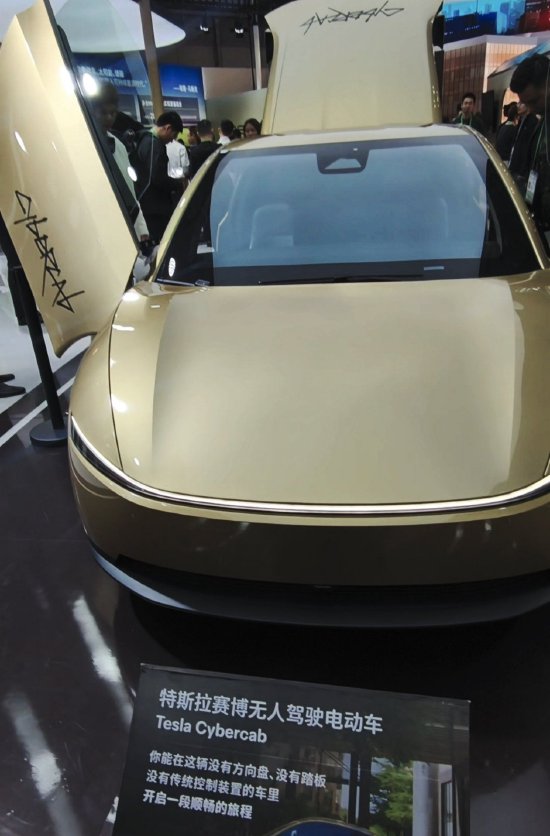
What was actually on the table, and why the exhibit is the smaller story
The exhibit itself is a communication device, not a product launch. The ninth CIIE ran November 5-10 at the National Exhibition and Convention Center in Shanghai, with the gold Cybercab standing in Hall 3H beside the newest Optimus humanoid robot, the recently launched Model Y Performance variant, and — for the first time — an exploded view of the Model Y. The decision-relevant content for Asia-Pacific readers is the operating dataset Tesla attached to that display, because it converts a photo opportunity into a benchmark other operators will now be measured against.
Two numbers carry the story. First, the ramp: 10 times the fleet in 30 days, from a small pilot pool to more than 300 Robotaxi vehicles serving Austin after a September 3 start. Second, the safety claim: as of October 18, roughly 5 million kilometers driven with no in-car safety operator, with zero airbag deployments recorded on the vehicles themselves and no collision in which the vehicle injured a person.
Is a 10x monthly ramp actually fast for driverless mobility?
Conclusion: fast for a hardware-constrained launch, but not yet proof of a mature service business. Ramp speed measures supply-chain and dispatching capability; unit economics still depend on utilization, which no operator publishes cleanly.
| Dimension | Tesla Cybercab, Austin (as disclosed at CIIE) | Regional comparator |
|---|---|---|
| Commercial start | September 3, Austin, Texas | Waymo entered 15 U.S. cities only after a staged test-then-drop-the-safety-driver-then-charge sequence |
| Fleet size at the 30-day mark | More than 300 Cybercabs, 10 times the opening number | Waymo operated roughly 4,000 robot taxis across 15 U.S. cities by late September 2026 (TechCrunch) |
| Demand cadence | Booked through Tesla's own ride-hailing app, single metro | Waymo averaged around 500,000 paid rides a week (TechCrunch, September 24, 2026) |
| Safety evidence offered | About 5 million kilometers unmonitored; zero airbag deployments; no injury-causing collision, as of October 18 | Disengagement- and discharge-reporting under U.S. federal rules; see the NHTSA automated vehicle safety framework |
Read this way, Tesla's claim is a supply-side claim: it can build and deploy driverless-capable cars faster than the sector expected. The demand-side claim — that each car earns enough per day — is still missing from the CIIE disclosure, and that gap should shape any Asia-Pacific procurement assumption.
Which three mechanisms made the ramp repeatable?
- Subtraction as a cost strategy. Deleting the steering column, pedals and traditional controls removes hardware, calibration and inventory. APACTechBriefing's analysis: the freed front volume also lets battery packaging and cabin layout be planned around algorithm execution rather than human reach, which is why the same design cannot be retrofitted onto a driver-centric car.
- A stated unit-economics target, not a vague promise. Tesla has publicly targeted a purchase price under 30,000 U.S. dollars and an operating cost below 0.30 U.S. dollars per mile; the cost figure Musk cites for mature operations is about 0.20 dollars per mile, and ARK Invest's Big Ideas 2026 modelling carried a similar fully loaded estimate at scale toward 2030. Any APAC operator comparing Robotaxi against chauffeured vans should demand this specific line item.
- One dense metro before many thin ones. Concentrating 300-plus vehicles in Austin keeps data quality, remote assistance and maintenance economics coherent. Breadth-first expansion, by contrast, spreads the same engineering team across too many edge cases.
What could stall it: the compliance gap most briefings skip
The regulatory layer is the weakest link in this case, and the most instructive for Asia-Pacific readers. Under current U.S. Federal Motor Vehicle Safety Standards, a vehicle sold for public roads must carry manual controls and mirrors; an exemption pathway exists but is capped at 2,500 vehicles a year per manufacturer, and reporting through early 2026 indicated no exemption filing for the Cybercab. Federal scrutiny followed almost immediately: NHTSA opened questions about how a control-free Cybercab was certified, seeking responses by September 30, while a March 2026 proposal to revise FMVSS No. 102 for vehicles built only for automated driving remains unresolved.
Operational money sits in the same gap. Fleets that lean on remote assistance and depot routines inherit billing and liability exposure of exactly the kind APACTechDigit already tracked in Tesla's emergency drive-away feature, where a driver-side workaround converts into a costly after-sales repair case. For a Robotaxi operator, the equivalent event is a dispatch decision gone wrong — so contract the disclosure rules before signing the fleet order.
Why a Model Y exploded view belongs inside a Robotaxi story
Tesla's first-ever teardown exhibit at CIIE was not decoration. Buyers in Asia-Pacific infrastructure and mobility deals increasingly ask for verifiable engineering artifacts — body structure, battery system and key components laid out — because those shorten due diligence and reduce the need for on-site audits. Pairing the exploded view with an unattended-mileage claim turns the booth into a single evidence package: how the car is built, and how the car behaved once it was on the road.
Three different clocks for Robotaxi in Asia-Pacific
- Mainland China — market-access signalling through a showcase at CIIE, with the product already localized to the point of an Asia debut for the production car.
- Singapore and Japan — operator-led entry on a slower timetable. Waymo announced on September 17, 2026 that it plans paid Robotaxi service in Singapore in 2028, landing its first Jaguar I-PACE units in late 2026 and running locally driven data collection through 2027, while naming Tokyo for commercialization the year before that. Waymo co-CEO Tekedra Mawakana framed Singapore as one of the safest, most efficient and forward-looking transport ecosystems in the world, and stressed coordination with the Land Transport Authority rather than a parallel ride-hailing layer.
- Chinese exporters — cost-first vehicle and stack exports running ahead of Western operator timelines. Pony.ai said in late March 2026 it expects to more than double its robotaxi fleet past 3,000 units across more than 20 cities (Reuters), and its ComfortDelGro partnership already serves Singapore riders; Baidu's Apollo Go runs fully driverless commercial service in Dubai, while WeRide planned 2,000 GXR deliveries during 2026.
Implication for APAC decision-makers: an Austin ramp and a Singapore launch are not the same race. One is constrained by rulemaking, the other by permit class, data-localization and training lead time of two to three years.
Action checklist for Asia-Pacific tech, mobility and platform leaders
- Ask every vendor for unmonitored mileage, the definition of a reportable event, and airbag or remote-intervention counts — the CIIE disclosure sets a new floor for what should be public.
- Model fares on cost per mile and daily utilization separately; a 10-times-in-30-days fleet curve says nothing about revenue per vehicle.
- Map the local rule path before the vehicle path: exemption, permit, pilot zone and data rules each add 12-18 months in most Asia-Pacific jurisdictions.
- Treat transparency artifacts — teardown exhibits, component sourcing, battery documentation — as a procurement deliverable, not marketing.
- Watch the Chinese cost curve as a pricing anchor for any pilot in Southeast Asia and the Gulf.
- Assume remote assistance is a cost centre, and contract response-time liability at the fleet level.
Reader questions
Was CIIE the Cybercab's first Asia appearance?
Yes. The gold production Cybercab shown at the Shanghai expo marked the model's debut in Asia, and it was presented without a steering wheel, pedals or traditional controls.
How much of the safety record is third-party verified?
The disclosed figures — about 5 million kilometers without an in-car safety operator, zero airbag deployments and no injury-causing collision, as of October 18 — are Tesla's own reporting. Federal review of the control-free vehicle was still open, so APAC buyers should treat the dataset as a starting point for due diligence rather than a certified record.
Why not simply sell the Cybercab to private riders?
Because U.S. road-vehicle standards assume a human driver. Until the pending rule revision or an exemption resolves, the design is economically viable mainly in a manufacturer-operated Robotaxi fleet.
Should Asia-Pacific cities expect the same 30-day ramp?
Not on that clock. Waymo's own Asia-Pacific plan stretches from late-2026 arrivals to 2028 commercial rides in Singapore, which is the realistic range once local permits and data rules apply.
Sources referenced
- China International Import Expo official site — 9th CIIE dates and venue, ciie.org
- NHTSA automated vehicle safety framework — nhtsa.gov
- TechCrunch, September 24, 2026, on Waymo fleet and ride-volume data
- Reuters, March 26, 2026, on Pony.ai fleet expansion plans
- Wikipedia entry on the Tesla Cybercab, citing the sub-0.30 U.S.-dollars-per-mile operating target
Corrections, data tips or a briefing copy for your regional desk: contact contact@apactechdigit.com.