
HALO vs. Helix, GR00T N1 and pi0.5: An APACTechDigit Decision Guide to Apple's Three-Tier Humanoid Stack on the Unitree G1
By Lynn Zhou | APACTechDigit — AIFrontierTech
Short answer: HALO is not a robot. It is a three-tier control stack that the Apple research team ran onboard a Unitree G1. It averaged 91% success over 360 single tasks in six real environments that had never been scanned or mapped, yet dropped to 50% on its hardest three-step sequence. That gap, not the headline number, decides whether the architecture fits your own system.
The disclosure landed on November 4, when the Apple research team posted the paper "Perceptive Humanoid Motion from Simulation" to arXiv as progress on its robot "brain" research, releasing code covering data generation, model training and deployment — motion generation, motion tracking, task orchestration, simulation and real-robot execution included. Validation ran on the G1 humanoid from Unitree. For teams comparing stacks instead of applauding demos, the open code is the real product: every layer and its cost is inspectable in the published paper.
What does HALO actually make a Unitree G1 do?
Whole-body spatial negotiation, not dexterous manipulation. On the HALO project page the robot pushes a box, follows a person, sits on a chair, turns sideways through a half-open door, and crouches or crawls under a table. Every one of those behaviours demands reading the surrounding space and re-posturing the body to fit the clearance available — a different problem class from grasping small objects.
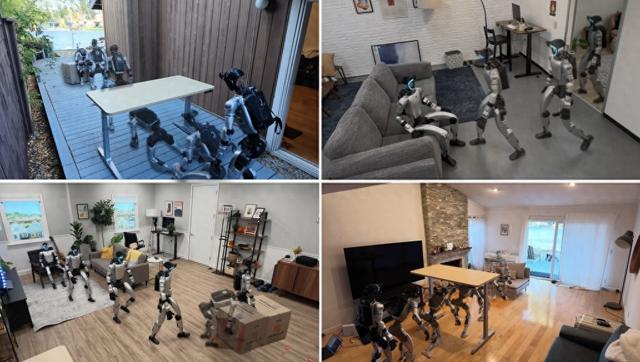
The G1 running HALO demonstrates crawling under a table, sitting on a sofa and pushing a box in different real environments. Image credit: HALO research team.
How is the three-tier control architecture organised?
By splitting one hard problem into three cheaper ones: understand the instruction, plan the body motion, execute the joints. The stack is organised as three levels — orchestration, motion generation, motion tracking — and each tier carries its own model, its own clock rate and its own failure mode.
- Orchestration tier. A vision-language model (VLM), by default Qwen3.6-35B-A3B running locally on the Mac mini the robot carries, sharing a single model-serving engine with the motion generator so the system works without a network connection. If stronger reasoning and planning are required, the tier can call a cloud model through an API.
- Motion generation tier. Qwen3.5-2B held as a parameter-frozen encoder, paired with a DiT decoder that plans the next about 5 seconds of whole-body motion from the current view and current subtask, replanning about 3 times per second.
- Motion tracking tier. A tracker trained through reinforcement learning and policy distillation, running 50 times per second, converting plans into joint commands from depth images plus the robot's own state.
Ambiguity is resolved only at the top. "Sit down" names no target, so the robot must judge from the scene where to sit; "sit on the chair" looks directly executable, but when a table blocks the path the orchestrator decomposes it into crouching through, approaching the chair, and sitting. That tier keeps watching the robot's own video stream, judges whether the current action succeeded, and advances or retries — while issuing just one explicit subtask to the generator at a time.
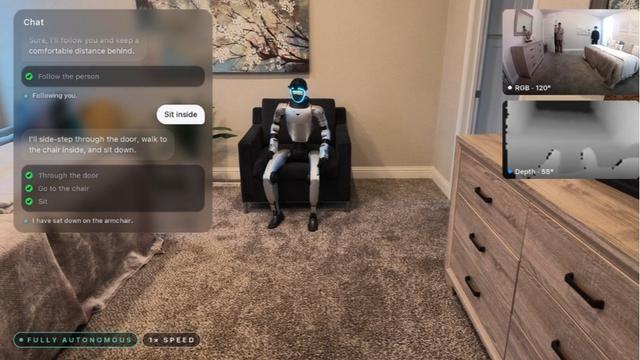
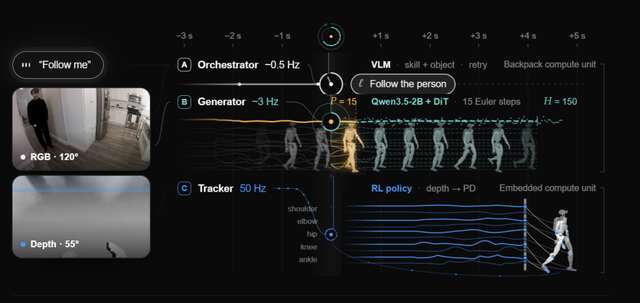
The three-tier control architecture: a vision-language model handles task orchestration, the motion generation module plans whole-body action, and the reinforcement-learning-trained motion tracker executes joint control. Image credit: stitched screenshots from the HALO project page.
How does HALO compare with Helix, GR00T N1 and pi0.5?
Conclusion first: HALO is the only one of these four whose headline evidence is zero-shot transfer of whole-body motion from purely synthetic data into unknown rooms. The others buy openness with human demonstrations, or publish against simulation benchmarks instead of real floors.
| Dimension | HALO (Apple research team) | Helix (Figure) | GR00T N1 (NVIDIA) | pi0.5 (Physical Intelligence) |
|---|---|---|---|---|
| Top reasoning tier | VLM orchestrator, Qwen3.6-35B-A3B, one subtask at a time | "System 2", about 7B parameters, roughly 7–9 Hz | Single vision-language-action foundation model | VLA co-trained on heterogeneous data |
| Action / control rate | Generator replans about 3 times per second; tracker runs 50 times per second | "System 1", about 80M parameters, 200 Hz, up to 35 degrees of freedom | Continuous robot control, GPU-class onboard compute | High-rate manipulation control |
| Main training data | about 300 hours of synthetic data from 1,000 procedurally generated simulated homes | roughly 500 hours of teleoperation | 88 real teleoperation hours expanded about tenfold with model-generated "neural trajectories" | Mixed sources: web data, other robots, real demonstrations |
| Real-robot evidence | 360 single-task tests in six unmapped environments, 91% average; 70% on three composed tasks | Company-reported multi-robot and logistics manipulation demos | Evaluated mainly on standard simulation benchmarks | Cleaning and multi-stage tasks in unseen homes |
| Transparency | Data generation, training and deployment code released | Closed model, public blog | Open model and paper | Public blog and papers |
Read this as an architecture comparison, not a leaderboard: no shared benchmark exists, so success counts cannot be subtracted from one another. The most useful contrast is the frequency split. Figure's published Helix profile pairs a slow language tier at roughly 7 Hz with a 200 Hz visuomotor policy; HALO chooses a mid tier replanning about 3 times per second above a tracker running 50 times per second. Slower replanning is affordable only because the tracker absorbs disturbance between plans — a design assumption worth stress-testing before you copy it.
Where does the compute sit — and what does the Mac mini choice buy and cost?
Conclusion: the design buys offline autonomy and a large local orchestrator, and pays for it with a memory ceiling and a research-grade payload. Reports on the deployment describe the G1's own onboard compute running the reinforcement-learning tracker, while a Mac mini tucked into a 3D-printed shell on the robot's back carries the VLM orchestrator and the DiT-based motion generator — separating the 50-times-per-second control loop from the slower language tiers.
Three numbers to weigh before adopting the pattern:
- Memory ceiling. The Mac mini M4 Pro tops out at 64 GB of unified memory with about 273 GB/s bandwidth, and community benchmarks put 30-billion-class quantised models near 11–14 tokens per second on that hardware. HALO does not publish orchestrator throughput, so treat these as reference points, not measurements of the system.
- Latency accounting. The paper measures onboard motion-generator latency on the Mac mini for model inference specifically, and reports orchestrator latency separately — so no honest end-to-end figure can be assembled from what is public. Instrument each tier on its own clock, the same discipline we applied when testing whether an on-device accelerator can take over a workload normally reserved for a GPU.
- Hardware alternatives. Reseller listings put a G1 EDU standard build around $17,990 with an NVIDIA Jetson Orin NX supplying about 100 TOPS of AI compute, base G1 units near $13,500 direct from Unitree, and top educational configurations climbing toward $83,900.
For architects, the desktop-class box is a research convenience rather than a product pattern: it proves a 35-billion-parameter-class MoE orchestrator can run untethered, but at a weight, power and cost envelope no consumer humanoid will accept. The cloud API path is the cheaper first experiment when planning quality matters more than offline operation — a constraint that tracks what memory, GPUs and power still cap when AI systems are scaled into products.
Is 91% a good number? Reading HALO's evidence before copying the recipe
Conclusion: 91% is a strong single-task result on unfamiliar floors; 50% is the deployment-relevant number.
The paper's own figures: 360 single-task tests across six real environments that were not pre-scanned or mapped, averaging 91% success. In one real environment, 10 tests for each of three composed tasks averaged 70%, and the hardest chain — "crouch through an obstacle — walk to the target — push the box" — reached 50%.
Two cautions, flagged as our analysis rather than the authors' claims. First, with 10 runs per composed task, an observed 50% rate is statistically consistent with a true rate somewhere between roughly one-fifth and four-fifths, so compositional evidence here is directional, not decision-grade; budget 100 or more runs before comparing two pipelines. Second, performance decays with sequence depth, which is why endurance-style evidence — Figure, for instance, reports multi-hour continuous Helix logistics runs on a narrow task family — is a different shape of proof, not a higher score.
The failure domain the Apple research team names explicitly: the robot perceives mainly through vision and cannot directly sense contact, so tasks involving heavy contact degrade when objects leave the camera view or are occluded, and adding tactile sensing is listed as a next step. If your workload is contact-heavy — insertion, laundry, packaging, assembly — the published result does not yet cover you.
Which data route fits which team: synthetic-first, teleoperation or co-training?
Conclusion: synthetic-first wins when body-space diversity is the bottleneck and human demonstrations are your scarcest asset; teleoperation wins when contact geometry and verified success labels must be real.
- Choose synthetic-first for posture and clearance behaviours — crawling, sitting, sidestepping through cluttered gaps — where physics is approximable and rendering is cheap.
- Choose teleoperation for contact-rich manipulation, where a wrong simulator silently poisons the policy and no render will tell you.
- Choose co-training — the pi0.5 pattern — if you already hold heterogeneous data and want open-world robustness without building a bespoke scene generator.
Cost context from public listings and vendor disclosures: dual-arm teleoperation rigs have been quoted at $50,000–$300,000, Stanford's Mobile ALOHA pushed a low-cost build toward $20,000, and Unitree's own open-source xr_teleoperate stack lets an operator drive a G1's arms and dexterous hand from an Apple Vision Pro, Meta Quest 3 or PICO 4 headset. Against that, HALO's about 300 hours of synthetic main training data trades human labour for machine hours — a trade that only pays off if new tasks stay cheap to author, which is precisely where the next section bites.
Case walk-through: how one "sit into the armchair" sample is manufactured
The pipeline runs in counter-intuitive order: motion first, scene second, camera last.
- The action generation model produces a motion sequence from a text prompt, waypoints and key poses; the project page splits "sit into the armchair" into walking forward, turning and sitting.
- Geometric checks screen the candidates, cutting foot sliding and body-into-floor penetration before anything is rendered.
- Surviving motions are placed into procedurally generated rooms, with the system searching for furniture arrangements that produce no collision.
- Simulation renders what the robot would see while executing, randomising lighting, colour tone and image blur for visual diversity.
- The same flow produces paired data binding "what it sees", "what instructions it receives" and "how it moves" for the generator and the tracker.
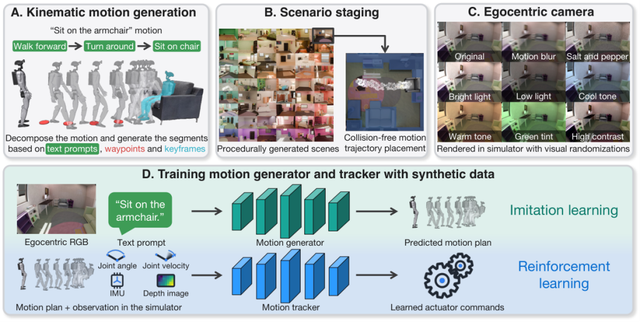
HALO's synthetic data generation and training flow: motion trajectories are generated first, placed into virtual scenes, then rendered from the robot's viewpoint to form paired training data for the motion generator and the motion tracker. Image credit: HALO paper.
What the pipeline costs, and where humans remain in the loop
- Main training data: 250 NVIDIA H100 GPU running about 48 hours to synthesise data from 1,000 simulated homes.
- Motion generator: imitation learning on 64 B200.
- Motion tracker: reinforcement learning and policy distillation on 4 H100.
Simulation did not eliminate human labour. The team states that adding a new physical task still requires hand-written prompts and manually designed key poses, and that some motions used human video or motion-capture material. That is the honest budget line for anyone replicating the result: GPU hours are quotable, but each new behaviour begins with a human authoring its motion skeleton — the same authoring cost that teleoperation was meant to remove.
Five misconceptions about HALO's real-world result
- "91% means it is deployable." The same stack halves to 50% on a three-step chain, and residual failures concentrate in contact the robot cannot feel.
- "It learned with no human data." Prompts, key poses and in some cases human video or motion capture still feed task creation.
- "This is Apple's robot." HALO is a research output of the Apple research team, validated on a third-party G1 from Unitree and driven by open Qwen models. Apple's own reported consumer robotics roadmap points at a home hub and a tabletop device, not a humanoid.
- "The brain must live in the cloud." The orchestrator defaults to local Qwen3.6-35B-A3B on the Mac mini and runs without a network.
- "These numbers are comparable with Helix or GR00T N1." Task families, trial counts and data sources differ; there is no shared benchmark to divide them.
Action checklist: what to reuse from HALO in your next two sprints
- Adopt the split clocks, not the brands: a language tier issuing one explicit subtask, a planner replanning about 3 times per second over the next about 5 seconds, and a learned tracker closing the loop 50 times per second.
- Freeze the language encoder and train only the action decoder when GPU budget is scarce — the Qwen3.5-2B plus DiT pattern is the cheapest imitation-learning path in this design.
- Synthesise locomotion and posture behaviours first; reserve teleoperation budget for contact-heavy tasks where simulator error is invisible.
- Instrument each tier separately and publish per-tier latency, so planner and orchestrator numbers are never silently summed.
- Test in environments nobody scanned or mapped, and report composed chains of three or more steps with at least 100 trials each.
- Add a contact or force signal early; depth image plus proprioceptive state leaves the dominant failure mode unobserved.
FAQ: the questions engineers ask first
Does HALO need an internet connection to run?
No, by default. The vision-language orchestrator runs Qwen3.6-35B-A3B locally on the Mac mini and shares its model-serving engine with the motion generator, so the robot can act in an un-networked room. Calling a cloud model through an API is an optional upgrade for harder planning problems.
How much of the system is real-world trained?
None of the headline training. Main training data is about 300 hours synthesised across 1,000 simulated homes, and the robot was evaluated zero-shot in six real environments that had never been scanned or mapped.
Which models do the heavy lifting?
Open third-party models: Qwen3.6-35B-A3B for orchestration and Qwen3.5-2B as a frozen encoder feeding a DiT decoder for motion generation, with the tracker learned through reinforcement learning and policy distillation.
Could a lab reproduce this on a Unitree G1?
The code path is open — data generation, model training and deployment are published — but the resource bill is 250 NVIDIA H100 GPU for about 48 hours of synthesis, 64 B200 for the generator and 4 H100 for the tracker, plus a Mac mini per robot.
What is the biggest unsolved gap?
Contact. The robot perceives mainly through vision, cannot directly sense contact, and degrades when objects leave the camera view or are occluded; the team names tactile sensing as a follow-up direction.
Bottom line
HALO's real contribution is an auditable budget: a language tier that decides, a generative tier that replans about 3 times per second, and a learned tracker executing 50 times per second, all carried on hardware a well-funded lab can buy today. The 91% single-task figure is credible precisely because the six environments were unmapped; the 50% three-step figure is the number that should steer your roadmap. If your workload is contact-heavy or long-horizon, treat this release as an architecture lesson and keep your teleoperation budget. If it is whole-body movement through human spaces, the open pipeline makes this quarter the right time to run a synthetic-data pilot.
Reference sources
- Apple research team, "Perceptive Humanoid Motion from Simulation", arXiv, November 4 — https://arxiv.org/html/2611.06908
- Figure, "Helix: A Vision-Language-Action Model for Generalist Robot Control" — https://www.figure.ai/news/helix
- NVIDIA et al., "GR00T N1: An Open Foundation Model for Generalist Humanoid Robots", arXiv — https://arxiv.org/html/2503.14734v1
- Physical Intelligence, "pi0.5: A VLA with Open-World Generalization" — https://www.pi.website/blog/pi05
- Unitree Robotics, open-source XR teleoperation for G1 and H1 — https://github.com/unitreerobotics/xr_teleoperate/blob/main/README_zh-CN.md
- Unitree G1 configuration and onboard compute listings — https://www.robotlab.com/store/unitree-g1-robot/ ; https://www.robotshop.com/products/unitree-g1-edu-standard-u1-humanoid-robot-us
- Robotics training-data statistics roundup (Helix roughly 500 hours; GR00T N1 88 hours expanded to about 827 hours) — https://cervo-tech.com/blog/robotics-training-data-statistics-2026.html
- MacRumors, "Apple's Work on Robots: What We Know So Far" — https://www.macrumors.com/guide/apple-robot/
Corrections, data requests or replication results for this review: contact@apactechdigit.com. APACTechDigit AIFrontierTech covers AI frontier systems with reproducible evidence rather than vendor copy.