
Nvidia Under Investigation: What Jensen Huang's Confession Means for Control, Succession and Asia-Pacific AI Buyers | APACTechBriefing
On November 8 local time, Jensen Huang told Nvidia staff in an internal memo that he had been unfaithful to his wife, and the board opened an independent investigation. Huang continues as CEO. The exposure is structural rather than personal: Nvidia has no dual-class shares, its founder controls 3.58% of the company through family vehicles, and no successor has ever been named in public. For Asia-Pacific technology and digital leaders, that turns a private matter into a governance variable with commercial consequences.
What is established, and what is still assumption
Start with the confirmed set. Jensen Huang sent the apology memo to employees on November 8 local time, the letter was later published publicly, and an Nvidia spokesperson stated that he remains CEO and that his duties are not interrupted. The board answered by seating a committee of independent directors supported by outside independent legal counsel.
Then the negative space, which matters as much. Nothing public shows that Huang's marriage, the family trusts or the shared voting arrangements have changed, and nothing shows Lori Huang acting alone to influence a director election or breaking with Huang on a shareholder decision. Analysts still treated the episode as a governance event rather than a gossip column: Bernstein's Stacy Rasgon called the reporting negative headline risk and pointed to Nvidia's significant key-man risk (Investing.com). The working read for APAC decision-makers is therefore simple — no verified change in control today, a newly priced probability of one tomorrow.
How 3.58% of a company still buys control
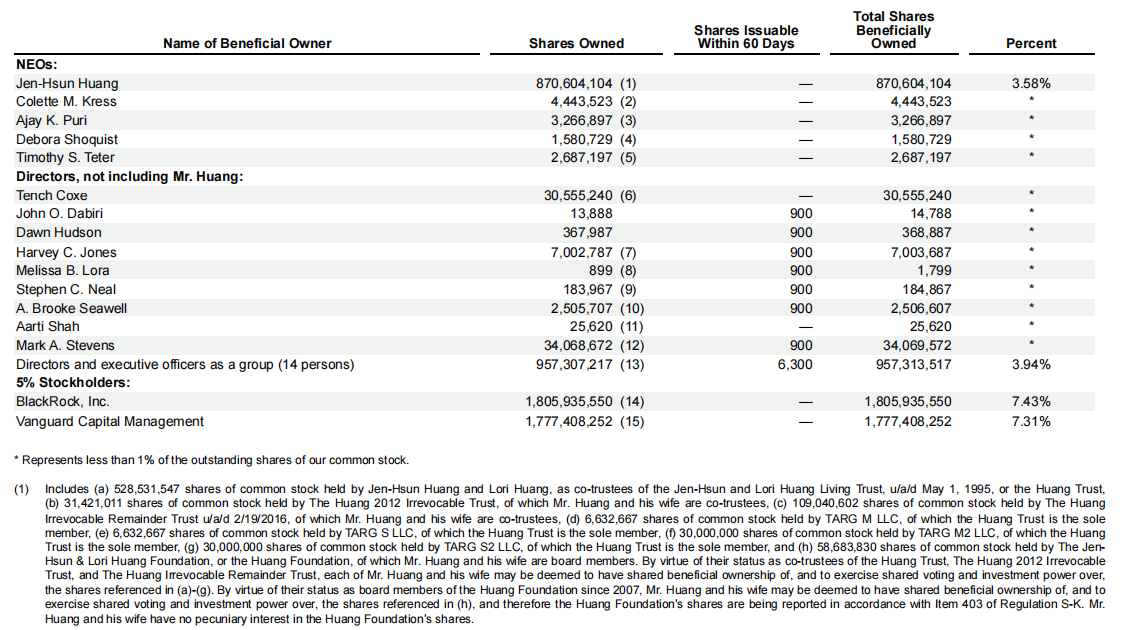
Nvidia's control model rests on two things: a fragmented shareholder register, and a founder who administers a large slice of it. The company did not adopt an A/B share structure. In May of this year, Nvidia submitted formal documents to the U.S. Securities and Exchange Commission (SEC); as of March 23, 2026, Jensen Huang held 870.6 million shares of common stock, equal to 3.58% of the company, all of it common stock. He has served as CEO for more than 30 years without a serious control fight.
Those shares do not sit in one account. They are distributed across family trusts and holding entities in which Huang and his wife Lori Huang are co-beneficiaries. The disclosed structure is reproduced in the chart below:
| Holding vehicle | Shares of common stock | Position inside the block Huang controls |
|---|---|---|
| Jensen Huang and Lori Huang Revocable Trust (the Huang Trust), with Huang and his wife as co-trustees | 528.5 million | 60.7% |
| Huang Irrevocable Remainder Trust, Huang 2012 Irrevocable Trust, TARG M LLC, TARG S LLC, TARG M2 LLC, TARG S2 LLC — either co-trusteed by Huang and his wife or with the Huang Trust as sole member | 213.7 million | Trust and entity vehicles |
| Jensen Huang and Lori Huang Foundation, where Huang and his wife sit on the board | 58.6838 million | Foundation vehicle |
| Shares over which Huang and Lori Huang hold joint beneficial ownership and shared voting and investment power | 801 million | 92% |
| Residual between the 870.6 million total and that joint block | 69.66 million | Ceiling on Huang's personal direct holding |
What a settlement would actually move
Conclusion first: the sensitive number is 92%, not 3.58%. Huang married Lori Huang before Nvidia was founded in 1993, so a divorce-driven division of property would touch the very mechanism that converts a minority stake into durable influence. Trim the 3.58% headline figure and a founder's stake thins; divide the 801 million-share joint block and the effect is far larger, because that block is what makes his control function in practice.
The limits of that inference should be stated plainly. How co-trustees reconcile votes and investment decisions depends on the specific terms of each trust agreement, and those terms are not public. Nothing in the current record indicates a change to the marriage, the trusts or the voting arrangements. This is a risk to monitor, not a fact to report.
Why the succession gap is structural, not a talent shortage
Nvidia is not short of able executives; it is short of designated authority. Only two holders on the register exceed 5%, and both are institutions: BlackRock, Inc. at 7.43% and Vanguard Capital Management at 7.31%. Among the five named executive officers, the other four each hold less than 1% of the common stock outstanding. The company has no chief operating officer. It employs more than 40,000 people and still runs flat, with dozens of direct business-line leads reporting to Huang himself.
The board is built the same way. There is no chairman; every member except Huang is an independent director, and the independents designate one lead independent director. Huang is the only management representative in the room. The board now has 11 members; it had 10 when the May document was disclosed, and all were re-elected at the June annual meeting. The other nine directors each hold less than 1%, the largest being Mark A.Stevens with 34.0696 million shares.
Huang, 63, has talked about the gap instead of filling it. In a podcast this March he said he had publicly stated that he does not trust succession planning, that anxiety about it is better handled by decomposing the problem and returning to the present, and that anyone who cares about the company's future should pass on knowledge, information, insight, skills and experience as often and as continuously as possible. The outcome he wants, he said, is to keep working in the role until the last moment of his life. That is a teaching philosophy, not a bench plan — and it is exactly the design flaw analysts mean when they describe Nvidia as carrying key-man risk.
Have outside shareholders ever redirected Nvidia?
Once, and the founder won. Starboard Value, the activist hedge fund known for demanding board seats, forcing operational change and launching proxy fights, wrote to Nvidia's board in 2013 while the company was pushing into multiple markets at once. Starboard's chief investment officer questioned whether Jensen Huang was leading the company to ruin. Huang took the advice seriously enough to exit the power-management market, then lobbied multiple institutional investors to keep funding CUDA rather than redirect that spending to shareholder returns. Tae Kim's account of the episode describes Starboard as holding only a small stake while pressing for board representation (CNBC). Nvidia's business direction did not bend to outside capital.
Two lessons follow. Fragmented ownership is not by itself a route to a control change. But the 2013 outcome depended on a founder whose stake, title and narrative were all intact — the three variables now under scrutiny at once.
What Asia-Pacific tech and digital leaders should watch next
- Filings, not headlines. Any change in Huang's beneficial ownership must be reported on a Form 4 within two business days of the transaction under SEC Section 16 rules (SEC.gov). A spousal transfer, a trust amendment or a shift in shared voting power would show up there first.
- Board redesign. The addition of a chairman, a named chief operating officer, or new directors into the 11-member board would be the first structural evidence of preparation.
- The next hard date. Nvidia is scheduled to report third-quarter fiscal 2027 results on November 17, 2026 (NVIDIA Investor Relations), with consensus near US$109 billion of revenue and about US$2.47 adjusted earnings per share against guidance of roughly US$108.0 billion, plus or minus 2%. Whether Huang fronts the full session is itself a data point.
- Regional supply context. Asia-Pacific demand is being planned for growth — third-party estimates put the regional data-centre GPU market at about US$22.15 billion in 2026, expanding at a 16.30% compound annual rate to US$47.14 billion by 2031 (Mordor Intelligence) — so any leadership churn lands on a supply curve that is already tight. Nvidia's AI Day Seoul 2026 proceeded without Madison Huang, and our separate read on why the RTX 5080 24GB slips beyond January 2027 shows how little schedule slack regional buyers currently have.
Action list: five moves that cost little and reduce exposure
- Map single-point dependencies. Write down which Nvidia-related decisions in your stack — pricing approvals, allocation escalations, roadmap commitments, custom silicon support — currently require founder-level attention, and name internal owners for each.
- Harden contracts. Add change-of-control and service-continuity language, plus allocation-visibility clauses, to new and renewing supply and cloud-capacity agreements; ask partners directly what happens to committed volume if leadership changes.
- Keep a second-source track alive. Maintain qualification of alternative accelerators and regional sovereign-AI capacity for training and inference workloads, without re-baselining the whole architecture on a headline.
- Assign a filings watch. Put one analyst on Forms 4, the annual proxy and Schedule 13D/A amendments, and pre-agree the thresholds that trigger a roadmap review — for example, a material change in the joint voting block or a new chief operating officer appointment.
- Separate the two risks in executive briefings: control and equity probability versus execution continuity. Conflating them is how organisations end up over-ordering silicon.
FAQ: what readers are asking
Is Jensen Huang still running Nvidia?
Yes. The company's spokesperson has said publicly that he continues as CEO with no interruption to his duties, while a committee of independent directors, advised by outside independent counsel, completes its investigation opened on November 8 local time.
How big is his stake, and does a minority holding really mean control?
He held 870.6 million shares of common stock, or 3.58% of the company, as of March 23, 2026. There is no dual-class share structure. Control comes from a fragmented register plus administration of the 801 million shares he and Lori Huang hold jointly through the Huang Trust, related trusts, the TARG entities and their foundation — about 92% of everything he controls.
Could a divorce actually change who controls Nvidia?
It could change the arithmetic without changing management in the short term, because the couple married before the company was founded in 1993 and the joint block is what makes his influence effective. There is no public evidence that the marriage, trusts or voting arrangements have been altered, so this remains a scenario to track.
Who is next in line?
No one has been named. Huang is 63 and said in a podcast this March that he does not trust succession planning. Nvidia has no chief operating officer and no chairman, and four of its five named executives each hold less than 1% of the company.
Should Asia-Pacific enterprises change their GPU procurement now?
Not dramatically. Contract language, a maintained second source and a filings watch address the realistic exposure. Rebuilding a multi-year AI infrastructure roadmap around a single governance headline is the more expensive mistake.
Sources and further reading
- SEC: Insider Transactions and Forms 3, 4 and 5
- NVIDIA Investor Relations — Events & Presentations (third-quarter fiscal 2027 results, November 17, 2026)
- Investing.com — Bernstein says Nvidia stock faces key-man risk amid CEO scrutiny
- CNBC — Nvidia and Starboard Value, excerpt from Tae Kim's book
- Mordor Intelligence — Asia-Pacific Data Center GPU Market
- Investors.com — Nvidia board launches independent investigation