
APACTechBriefing | Camera-Free Fall Detection at CIIE 2026: What Sony China's Wi-Fi Sensing Bet Means for Aging APAC Markets
At the ninth China International Import Expo (CIIE), Sony (China) Co., Ltd. gave a global debut to a privacy-friendly fall-detection system that reads human movement from Wi-Fi signals rather than cameras or wearables. For Asia-Pacific buyers the takeaway is narrow but decisive: the two rooms where seniors most often fall — bedroom and bathroom — can now be covered without any imagery, and the alerting chain runs on radio hardware.
The launch landed during CIIE, staged 5-10 November 2026 in Shanghai, an edition that assembled 4,142 overseas exhibitors from 162 countries and regions and more than 480 debut products, a record for the event. Read past the ribbon-cutting, the announcement is a test case for a category APAC operators have been waiting on: ambient sensing that survives privacy review, procurement review and family review at the same time.
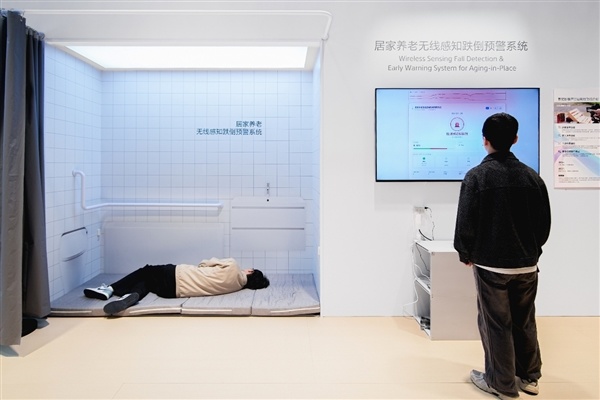
What did Sony China actually put on the shelf?
Conclusion first: this is a signal-analytics product, not a vision product. The system senses human activity through Wi-Fi; it requires no additional wearable device and captures no imagery, positioning it for home environments such as bedrooms and bathrooms as well as nursing homes and community eldercare service scenarios, where it helps caregivers discover a fall promptly.
- Sensing path: body movement alters how radio waves propagate, so the system collects channel state information (CSI), then combines human motion features with deep-learning models to identify a fall event in real time.
- Notification path: an on-site audio-visual alert fires locally, while warnings are pushed through an app or mini-program to caregivers.
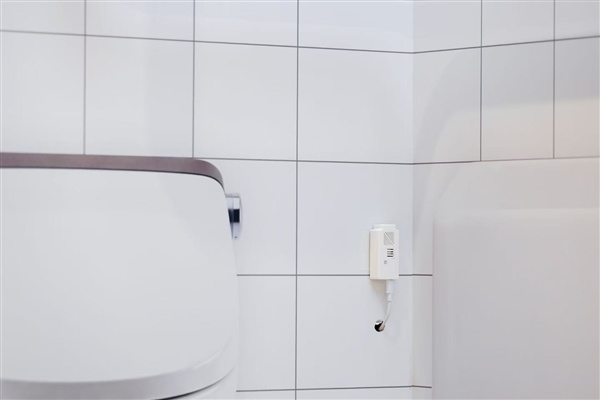
- Bill of materials: only a Wi-Fi transmitter, a receiver and a data processor — no camera, no image capture, which removes image-based privacy exposure at the root.
- Detection coverage: single-person detection including common fall types such as slow falls and slips.
- Commissioning: the unit enters monitoring state automatically once powered on, with no complex tuning, which matters for rapid rollout in both homes and institutions.
Why does dropping the camera matter more than another accuracy claim?
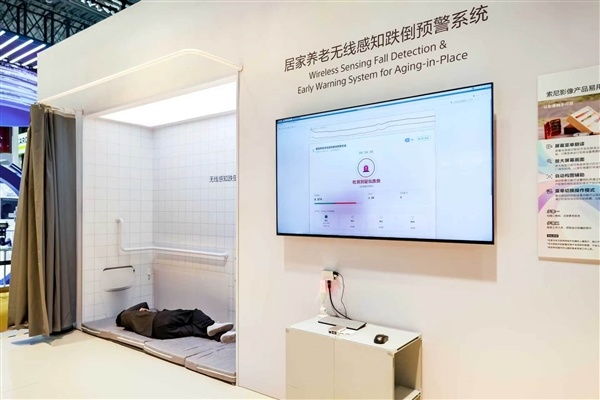
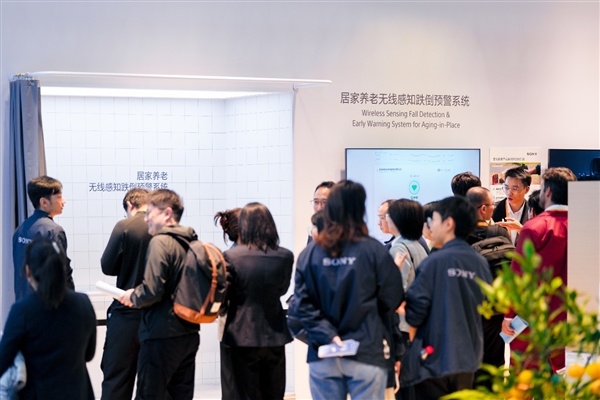
Because in eldercare the blocker is refusal, not resolution. "A lot of older people do not want a camera in the house filming them all day," said Liu Shijia, a senior manager in Sony's corporate information and media department, describing the design brief behind the product; she added that the system infers activity and posture from how walking and breathing disturb the reflection and propagation of Wi-Fi signals, which lets it distinguish a fall from someone simply sitting down. At the expo the difference was demonstrated physically: on Sony's stand a mock bathroom was built for testing, staff simulated a fall, and an alarm was triggered and mirrored on the wall-mounted screen, with on-screen confirmation of a person on the floor appearing in about three seconds according to coverage carried by the Beijing municipal government portal. Visitors could step into the space themselves and experience the fall simulation — the system raising an alarm while "seeing no picture" at all. The same two images that make the pitch convincing to operators also make it convincing to the person being monitored: older residents keep their daily routine undisturbed because nothing is worn, while households and care facilities avoid the discomfort of camera footage, so caregivers receive fall alerts without adding video surveillance.
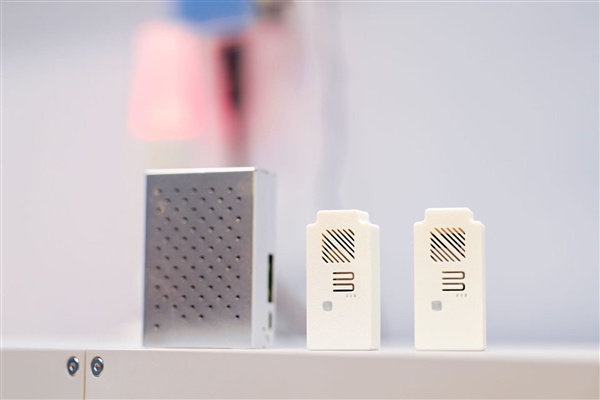
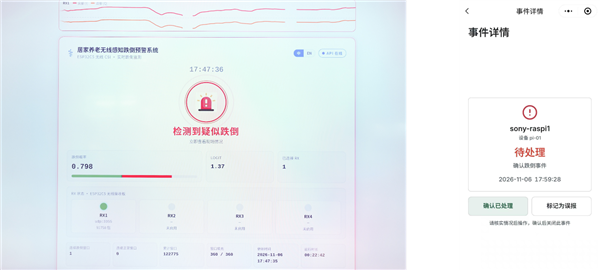
Privacy constraints are becoming a product-spec input across Asia-Pacific rather than a legal afterthought — a pattern visible in consumer software too, as we compared in Apple Intelligence's rollout in China.
How does Wi-Fi sensing compare with cameras, wearables and radar?
Conclusion: each competing modality fails one adoption test that radio-frequency sensing passes. The table below weighs them on the four criteria APAC procurement teams ask about; the ratings are our analysis of the master deployment facts plus public technical literature, not vendor benchmarks.
| Criterion | Camera / vision | Wearable + pendent button | Radar or UWB installed per room | Wi-Fi sensing (Sony China system) |
|---|---|---|---|---|
| Works in bedrooms and bathrooms | Legally and culturally blocked in most markets | Yes, if worn | Yes, but line-of-sight sensitive | Yes, no imagery captured |
| User compliance over 12 months | High refusal among residents | Weak — charging and forgetting | Neutral | High — nothing to wear |
| Installed base reuse | New cabling and storage | Device per person | New sensors per room | Transmitter, receiver, data processor only |
| Standards maturity | Mature video standards | Mature BLE ecosystem | Fragmented | IEEE 802.11bf-2025 was published on 26 September 2025, giving WLAN sensing a common specification layer |
Why now: the demographic, policy and standards clock
Conclusion: the timing is not exhibition-driven; it is demand- and rule-driven. China's National Bureau of Statistics reported in its 2025 statistical communique that the population aged 60 and above reached 323.38 million, or 23.0 per cent of the total, by the end of 2025. The World Health Organization's falls fact sheet puts the clinical stake in perspective: falls cause around 684,000 deaths a year and are the second leading cause of unintentional injury death worldwide, with roughly 71 per cent of fall deaths in 2023 involving adults aged 60 and older.
Regulators have moved the procurement door open at the same moment. In January 2026 eight central Chinese departments, including the Ministry of Civil Affairs, published guidelines pushing advanced technology — brain-computer interfaces, exoskeleton robots, muscle suits — into elderly care, according to Xinhua. On 6 November 2026, days after CIIE opened, six agencies including the Ministry of Civil Affairs and the Ministry of Industry and Information Technology issued measures encouraging smart eldercare devices for life assistance, safety protection, health monitoring and emergency rescue. Earlier, in June 2025, MIIT and the Ministry of Civil Affairs launched a joint pilot programme for smart eldercare robots running through 2027, with home-setting deployments specified at no fewer than 200 households and 200 robot sets. For vendors, that sequence converts "privacy-friendly" from marketing language into a tenderable requirement.
What the Shanghai pilot says about regional differences in APAC
Conclusion: the pilot is where a launch becomes an install base, and APAC markets will not adopt in lockstep. The system is already in trial deployment in Shanghai, where live operation is being used to further verify stability and detection accuracy, and it is designed to fit multiple care settings — home-based elderly care, public health service centres, nursing homes, rehabilitation and wellness institutions, and medical institutions — providing round-the-clock protection for older adults.
Japan, meanwhile, is the harder and richer market: the Cabinet Office's annual report on the ageing society counts roughly 36 million people aged 65 or more, close to 29 per cent of the population, with long-term care staffing rather than monitoring technology as the binding constraint. That difference splits the region into two buying centres. Labour-scarce markets buy alert latency and workflow integration; markets with family-carer coverage buy acceptance and refusal-proof form factors. Sony's build order is also a signal about where this category is being engineered: the system was developed in-house by the Sony China Research Institute as local R&D, and the work involved collaboration with the University of Science and Technology Beijing — evidence that China-based sensing R&D is now feeding a global launch rather than a China-only SKU. The same localisation dynamic is visible in physical AI, as our case review of heavy-load humanoid robots in APAC warehouses shows.
Which risks should buyers pressure-test before signing?
Conclusion: the unresolved items are operational, not scientific. Flagged as our analysis rather than vendor disclosure:
- Multi-occupant homes. The disclosed capability is single-person detection, so households with several residents or shared institutional rooms need a clear story on how a second body affects classification.
- False-alarm economics. No sensitivity, specificity or false-positive figures were published at CIIE, and every unnecessary dispatch carries staff cost and alert fatigue.
- Radio environment dependence. CSI-based reading assumes a stable RF baseline; dense 2.4/5 GHz estates, moving curtains and pets all deserve on-site trials before fleet purchase.
- Data classification. No image is captured, but signal-derived posture data about an identifiable person is still personal data — confirm retention, local processing and cross-border handling before exporting the model outside China.
- Alert plumbing. App and mini-program notification must be mapped to nurse-call or emergency-contact workflows; the demo loop ends at a screen, not at a responder.
Action list for the next two quarters
- Run a 60-day single-room trial in the highest-refusal space first — bathroom or bedroom — and measure alerts per occupied-night, not detection claims.
- Write "no imagery" into the requirement document alongside fall-detection functions, so camera-based alternatives are scored out early rather than debated late.
- Ask vendors which CSI features they consume and whether they will interoperate once IEEE 802.11bf-certified chipsets reach the market, so a 2026 pilot does not lock in a 2028 refresh.
- Tie pilots to policy windows — the 2025-2027 MIIT and Ministry of Civil Affairs robot-and-device pilot channels and the November 2026 age-friendly product measures both create subsidised deployment slots.
- Price against labour, not hardware. Third-party estimates for the global fall-detection category diverge widely, from about US$531.7 million for 2026 (Persistence Market Research) to US$1.59 billion the same year (Precedence Research), an immature-category spread that makes an ROI case built on night-shift coverage more durable than one built on device cost.
Frequently asked questions
Does the system replace my existing Wi-Fi network?
No. The disclosed hardware is a Wi-Fi transmitter, a receiver and a data processor, so it operates alongside — not instead of — in-building networking, and it powers on straight into monitoring without complex commissioning.
Can it tell a fall from sitting down?
That is the core claim. By tracking how movement and breathing alter signal reflection and propagation, and by matching human motion features with deep-learning models, the system is designed to confirm a fall rather than a rest; Sony's Shanghai pilot exists precisely to validate stability and detection accuracy under real use.
Where is it usable today?
It targets home environments plus nursing homes, community eldercare, public health service centres, rehabilitation institutions and medical institutions, with trial deployment under way in Shanghai.
Is this a China-only product?
The debut was global, and the developer is local — the Sony China Research Institute, working with the University of Science and Technology Beijing. Export depends on app and mini-program alerting being swapped for locally compliant notification stacks, and on the data-classification question above.
Bottom line
The interesting part of Sony China's CIIE announcement is not another sensor, but the removal of the objection that has stalled camera and wearable monitoring in Asian households for a decade. Once a fall can be confirmed without footage, eldercare moves from a consent argument to a service-level argument: latency, false alarms and responder integration. Buyers who pilot now, while policy channels are funding trials and 802.11bf silicon is still arriving, get to set those specifications rather than inherit them.
Verified sources
- China National Bureau of Statistics, Statistical Communique of the People's Republic of China on the 2025 National Economic and Social Development — https://www.stats.gov.cn/english/PressRelease/202602/t20260228_1962661.html
- World Health Organization, Falls fact sheet — https://www.who.int/news-room/fact-sheets/detail/falls
- IEEE 802.11 Working Group, standards approvals including IEEE 802.11bf-2025 — https://www.ieee802.org/11/
- Beijing municipal government portal coverage of debut exhibits and the fall-warning demo at the ninth CIIE — https://www.beijing.gov.cn/fuwu/lqfw/gggs/202611/t20261107_4936626.html
- Ecns.cn, opening figures for the ninth CIIE — https://www.ecns.cn/hd/2026-11-05/detail-ihfmuiku4866060.shtml
- Xinhua, China to promote tech-enabled elderly care (January 2026 guidelines) — https://english.news.cn/20260113/e69a9ed62b8946848e5f59cae7d3a540/c.html
- 21jingji.com, six-department measures on age-friendly product consumption (6 November 2026) — https://www.21jingji.com/article/20261106/herald/ed27d4a080659ddc116335966bcb9765.html
- Fujian Provincial Department of Civil Affairs reprint of the MIIT and Ministry of Civil Affairs eldercare-robot pilot notice — https://mzt.fujian.gov.cn/gk/wpldq/202506/t20250610_6923633.htm
- World Economic Forum on Japan's longevity economy, citing 36.25 million people over 65 — https://www.weforum.org/stories/sustainable-development/japans-longevity-economy
Contact the APACTechDigit briefing desk at contact@apactechdigit.com. Written by Lynn Zhou for the APACTechBriefing column.