
Huaqiangbei RTX 50 Pullback: A Model-by-Model Decision Matrix for APAC GPU Buyers | APACTechBriefing
Verdict first: Huaqiangbei's GPU slide is a discount off inflated street prices, not a return to list prices. After the RTX 50 series climbed for 11 trading days, the counter board turned down on October 28, several models lost thousands of yuan within days, and the RTX 5080 slid from nearly RMB 20,000 to around RMB 16,000. Even so, mainstream cards still change hands at roughly 1.7 times the suggested retail price, so "cheaper" and "fairly priced" remain two different claims.
For procurement leads, resellers and IT managers across Asia-Pacific, the operational question is not whether a correction happened but how to use it. Below, APACTechBriefing benchmarks the pullback against official China pricing and global premium data, then converts the result into three sourcing plays — buy, wait, switch — with the trade-off each one carries.
What changed at Huaqiangbei, and what did not
The reversal was a panic unwind on both ends rather than a demand story. CCTV Finance reported that the 11-day run-up, stoked by overseas production-halt speculation, broke on October 28, with some SKUs shedding thousands of yuan in a short window.
Concrete markers of the move:
- RTX 5080: from a peak of nearly RMB 20,000 to around RMB 16,000 — roughly a 20% cut from the high.
- Line-wide level: the average street price of mainstream RTX 50 series cards is still 1.7 times MSRP, because the earlier spike has not been digested.
- Quote stability: shop owners attribute the swings to hoarding by agents and merchants, which is why a counter price quoted in the morning may not be honoured in the afternoon.
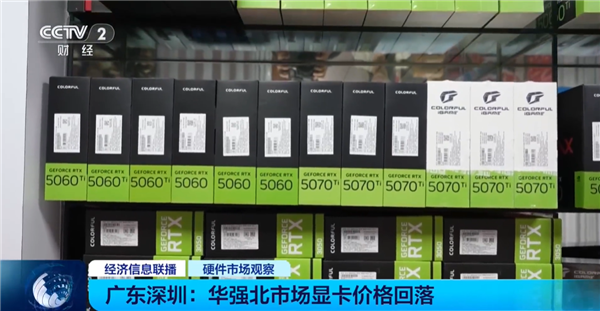
What did not change is the absolute level. Buyers at the top of the stack are still paying close to double list price: the correction trimmed the fear premium, not the structural one.
How far above list price are you actually being quoted?
Anchor to the manufacturer's own China pricing, not to last month's peak. Nvidia's mainland price guidance lists the GeForce RTX 5080 from RMB 8,299, a figure reproduced in board-partner price sheets documented by Tom's Hardware. Measured against that anchor, today's Huaqiangbei quote sits near 1.9 times list, while the recent peak was close to 2.4 times.
| Reference point | Number | Read for buyers |
|---|---|---|
| Nvidia China list, RTX 5080 | from RMB 8,299 | The only stable benchmark on the board |
| Huaqiangbei peak, RTX 5080 | nearly RMB 20,000 | About 2.4x list: scarcity pricing at its extreme |
| Huaqiangbei now, RTX 5080 | around RMB 16,000 | About 1.9x list, roughly 20% off the high |
| RTX 50 series line average | 1.7x list | The premium is whole-line, not flagship-only |
| US and global tracking, RTX 5090 | 370% above MSRP in the US; about 262% globally in TechSpot's Q4 2026 survey | Buying abroad is not an automatic discount |
The denominator matters. A 20% fall off a 2.4x premium is still a 1.9x premium, and the same squeeze is running in every other market we track, which caps how far a Huaqiangbei-only discount can travel.
Why a correction is unlikely to become a reset
Three forces keep the floor elevated, and all three sit upstream of the counter.
- Channel cost is still rising. Board partners have repeatedly repriced the line: Tom's Hardware recorded MSI and Colorful pushing RTX 50 distributor price sheets as much as 59% above MSRP in China in a single pass.
- Memory cost, not game demand, sets the floor. Industry trackers such as Astute Group tie 2026 GPU repricing to AI data centres absorbing DRAM and GDDR capacity — a supply-side squeeze no street price correction resolves.
- SKU expectation risk. Discontinuation rumours and model handovers created the original rally and can reprice the board within a day.
Our read: until memory cost normalises or Nvidia frees up supply, treat the current dip as spread compression rather than a trend change. This is editorial analysis, not a confirmed forecast.
Overseas demand is now part of the local price board
Huaqiangbei's quote is no longer a mainland-only number. Overseas purchasers have been moving through stalls to request prices, lifting cross-border sourcing of graphics cards and memory modules. One trader told reporters that in October this year, sales to foreign customers accounted for more than 50% of his turnover. Shenzhen trade reporting adds that Huaqiangbei electronics now ship to more than 190 countries and regions.
The implication for APAC teams is blunt: a genuine bargain at the counter is competed away within hours, and buyers quoting in HKD, USD or SGD bid against the same pallets. Sourcing plans should assume the discount window is short and internationally arbitraged.
Buy, wait or switch: a decision matrix
| Play | Best fit | Potential gain | Trade-off and risk |
|---|---|---|---|
| Buy now | Projects with a fixed install date; workstation builds already blocked on hardware | About 20% off the recent peak on the RTX 5080 | Still 1.7x-1.9x list; no price protection if the slide continues |
| Wait | Discretionary upgrades; teams with cards that still do the job | A possible further trim toward the 1.7x line average | Model handovers can reprice upward; agent cost hikes may pass through again |
| Switch | 1080p/1440p fleet refreshes, editing bays, capex-capped cost centres | Older or rival SKUs closer to list, better cost per frame | Less VRAM headroom, shorter support runway, more resale and returns friction |
In our scoring, "wait" wins only when the build has slack; "buy now" wins on delivery certainty rather than on price; and "switch" offers the best cost per frame as long as buyers match VRAM to the workloads they actually run.
Procurement checklist for the next two weeks
- Require written quotes with a validity window of at least 24 hours, given that the morning board and the afternoon board can differ.
- Set a premium ceiling before negotiating: anything above 1.5x list should need a written business case.
- Split GPU, memory and storage into separate RFQs — the squeeze is uneven across those bills of materials.
- Price an escape route: our breakdown of the RTX 3060 revival under the RTX 50 supply squeeze records which older SKUs channel partners are pushing instead.
- Track changeover risk: Nvidia's rebuild of its China GPU shelf around the RTX 5080 24GB handover is the variable that could end the current dip.
- Benchmark beyond Huaqiangbei: TechSpot's Q4 2026 survey puts even mid-range RTX 50 cards 40%-68% above MSRP in the US, so "buy overseas" is not a default saving.
- Log every quote with date, time and tier, so you can prove whether the correction is real at your price point.
FAQ: what APAC buyers ask us first
Is the RTX 5080 finally cheap?
No. It is about 20% lower, from nearly RMB 20,000 to around RMB 16,000, against a China list price starting from RMB 8,299.
Should I wait for the decline to continue?
Only if your project can absorb a surprise. The 1.7x line average shows the earlier spike is barely digested, and upstream cost pressure has not stopped.
Why does the counter move so fast?
Merchants point to stockpiling by agents and shop owners, which turns pricing into an intraday exercise rather than a weekly one.
Are overseas buyers driving the volatility?
They are now a major demand pool: in October this year, one Huaqiangbei seller reported more than 50% of his sales going to foreign customers.
Does this say anything about AI hardware demand?
Yes. The same memory and allocation squeeze that distorts consumer GPUs is what keeps pulling supply away from them toward data-centre products.
Sources and further reading
- CCTV Finance's report on the Huaqiangbei reversal, summarised in a Yicai market brief — https://www.yicai.com/brief/103430998.html
- Gamersky on RTX 5080 counter prices falling from nearly RMB 20,000 to RMB 16,000 — https://www.gamersky.com/hardware/202611/2242614.shtml
- Tom's Hardware on MSI and Colorful raising RTX 50 channel prices in China by up to 59% — https://www.tomshardware.com/pc-components/gpus/msi-and-colorful-raise-nvidia-rtx-50-series-prices-in-china-by-up-to-59-percent-across-the-entire-lineup-change-in-distributer-pricing-suggests-gpu-price-hikes-are-on-the-way
- TechSpot, "GPU Prices Are Spiraling Out of Control: Q4 2026 Update" — https://www.techspot.com/article/3192-gpu-pricing-q4-2026/
- Astute Group on AI-driven memory shortages resetting GPU pricing — https://www.astutegroup.com/news/general/gpu-pricing-set-for-reset-as-ai-driven-memory-shortages-push-costs-sharply-higher/
- The Malaysian Reserve on Huaqiangbei's export footprint across more than 190 countries and regions — https://themalaysianreserve.com/2026-08-18/shenzhens-huaqiangbei-connects-chinese-smart-tech-with-global-consumers/
Compiled by Lynn Zhou for APACTechBriefing on APACTechDigit. Sourcing questions: contact@apactechdigit.com.